


Trust quotient in investing is the degree of confidence an investor can place in a fund manager based on verifiable evidence not marketing. A high trust quotient means holding through 30% paper losses without panic. A low one means a 10% dip triggers a redemption call. The difference between those two outcomes, compounded over a decade, is enormous.
According to the investment team at Chanakya Capital, a SEBI-registered portfolio manager, “the real test of trust quotient isn’t when the portfolio is up 40% it’s whether the investor stays through the inevitable correction without needing the manager to explain away every red quarter.”
Evaluating a fund manager and trying to separate genuine conviction from well-packaged marketing?
What Should You Look At Before the Return Number?
Four things that create genuine, evidence-based trust:
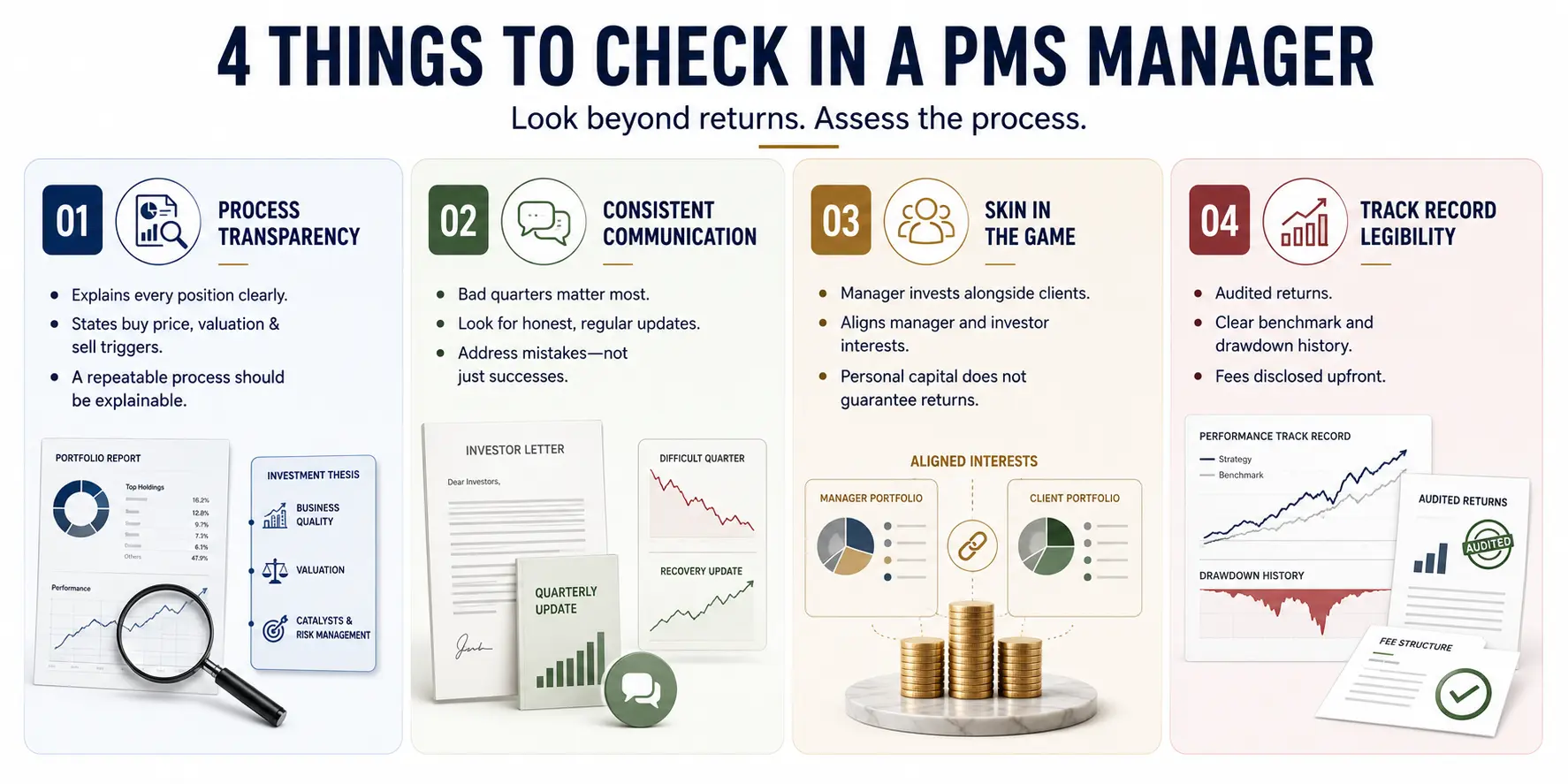
Trust quotient compounds like returns do it builds slowly through consistent behaviour and collapses fast through a single moment of misalignment. That’s why transparency and alignment matter as much as the strategy itself.
Why Does Trust Quotient Matter More in a Concentrated Portfolio?
A 60-stock fund doesn’t test trust quotient the way a 15-stock one does. Four reasons why:
- Volatility tolerance: A concentrated PMS can swing 20–30% in a quarter even when the thesis is intact an investor without trust in the process redeems at the bottom and misses the recovery, which is where long-term compounding actually gets destroyed.
- Position sizing decisions: A 12% single-stock position requires the investor to understand and accept the logic without that, every large position feels like recklessness, and the relationship breaks at the first sign of pressure.
- Holding through corporate events: Rights issues, promoter pledging, temporary earnings misses concentrated portfolios go through these regularly, and low trust quotient means exits at exactly the moments the manager is most confident.
- Long time horizons: Sitting through multiple full market cycles is only possible if the investor isn’t second-guessing the manager every six months on short-term noise.
Trust built on process is durable. Trust built on recent performance isn’t and that difference is what first-principles investing is built around.
Why Choose Chanakya Capital?
Chanakya Capital Services Pvt. Ltd. is a SEBI-registered portfolio manager (INP000006040) running concentrated listed equity portfolios for HNIs, NRIs, and family offices through onshore PMS and a Category III AIF at GIFT City IFSC. Every position in the portfolio has a written thesis. Every quarter has a frank communication to investors including the bad ones. Fund managers invest their own capital in the same strategies as clients, and the firm has never charged a performance fee on returns that didn’t first make investors whole.
Trust quotient isn’t something Chanakya claims it’s something investors build after reading the quarterly letters, seeing how the team handled the 2020 crash, and watching the portfolio behave exactly the way the process said it would. That kind of track record takes time. But it’s the only kind worth having.
FAQ
Frequently Asked Questions
What is trust quotient in investing?
The verifiable confidence an investor places in a fund manager’s process, transparency, and alignment not their marketing.
Why does trust quotient matter more for long-term investors?
Long-term compounding requires staying invested through drawdowns that’s only possible with genuine confidence in the manager.
How do you measure trust quotient in a fund manager?
Through process transparency, communication quality during bad quarters, skin in the game, and audited track record legibility.
Does a concentrated PMS require higher trust quotient than a diversified one?
Yes higher position sizing and volatility means investors need stronger conviction in the manager’s process to hold through corrections.
