
There’s no right PMS-to-AIF ratio it depends on liquidity needs, time horizon, tax situation, and how much of the corpus can stay locked. PMS gives listed equity exposure in your own name with anytime liquidity. A Category III AIF at GIFT City gives NRI HNIs USD denomination and cleaner tax treatment. Category II AIFs trade liquidity for private equity or private credit returns. Most HNI portfolios above ₹5 crore benefit from holding both but the proportions follow the investor’s situation, not a formula.
According to the investment team at Chanakya Capital, a SEBI-registered portfolio manager, “HNIs who split without a framework end up with too much locked in an AIF when they need liquidity, or too much in PMS when they could be accessing better risk-adjusted returns in alternatives. The allocation has to start with cash flow, not products.”
Holding a large corpus across multiple structures with no clear allocation logic tying them together?
What Should Drive the PMS vs AIF Allocation Decision?
Four factors that actually determine the right split not the sales pitch of whoever is selling the product:
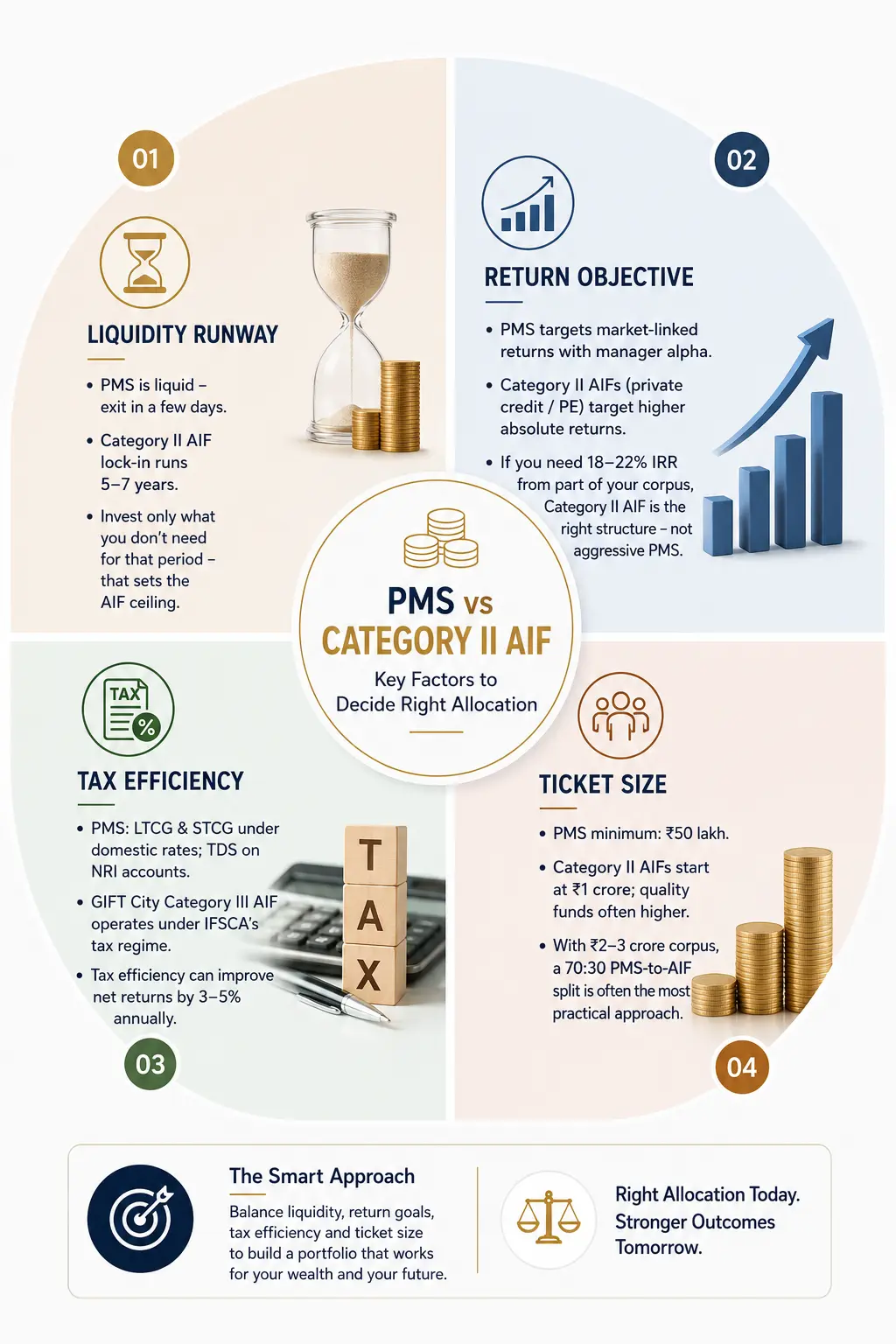
The split isn’t static either. As the corpus grows and liquidity improves, the AIF allocation can expand most seasoned HNI portfolios above ₹10 crore run 50:50 or tilt heavier toward alternatives. See who qualifies to invest with Chanakya Capital across PMS and AIF structures
What Does a Practical PMS and AIF Split Look Like?
Three broad corpus sizes, three different approaches not rules, just frameworks:
- ₹1–3 crore corpus: Most of this sits in PMS liquidity matters more at this size, and locking 30–40% into a Category II AIF leaves too little flexibility; a GIFT City Category III AIF works here for NRIs because it’s open-ended, so the liquidity constraint disappears.
- ₹3–10 crore corpus: A 60:40 or 50:50 split between PMS and AIF becomes viable the PMS handles the liquid core, and the AIF sleeve goes into private credit or a concentrated alternatives strategy where the illiquidity premium is real and the ticket size is manageable.
- ₹10 crore and above: Allocation to alternatives can run 40–60% without creating a liquidity problem, especially when the PMS portion is in a high-conviction listed equity strategy that can be liquidated quickly if needed family offices at this level often run three or four AIF commitments across vintage years to smooth out the lock-in timing.
But structure only works if the underlying managers are disciplined. A badly run AIF locked for 7 years is far more damaging than a mediocre PMS you can exit in a week.
But the right split also depends on what’s driving the equity core a concentrated, high-conviction PMS changes the risk profile of the whole portfolio differently than a diversified one does, which is why evaluating a PMS beyond just returns matters before committing to any allocation.
Why Choose Chanakya Capital?
Chanakya Capital Services Pvt. Ltd. is a SEBI-registered portfolio manager (INP000006040) managing concentrated listed equity portfolios for HNIs, NRIs, and family offices through onshore PMS and a Category III AIF at GIFT City IFSC. The investment team brings 35+ years of combined Indian equity experience, runs 12 to 18 high-conviction positions, and invests its own capital in the same strategies as clients.
For HNIs working through the PMS-AIF split, Chanakya sits on the listed equity side a liquid, transparent, first-principles PMS or open-ended GIFT City AIF that anchors the portfolio while the alternatives sleeve does its work elsewhere. No exit load. No benchmark hugging. No fee on top of a fee.
FAQ
Frequently Asked Questions
What is the minimum investment for PMS and AIF in India?
PMS minimum is ₹50 lakh; most Category II AIFs start at ₹1 crore per SEBI norms.
Can HNIs hold both PMS and AIF at the same time?
Yes most HNI portfolios above ₹5 crore benefit from holding both simultaneously.
Is a GIFT City AIF better than onshore PMS for NRI HNIs?
For large offshore allocations, yes: better tax treatment, USD denomination, and no repatriation cap.
How long is capital locked in a Category II AIF?
Typically 5 to 7 years; Category III AIFs at GIFT City can be structured as open-ended with no lock-in.
