
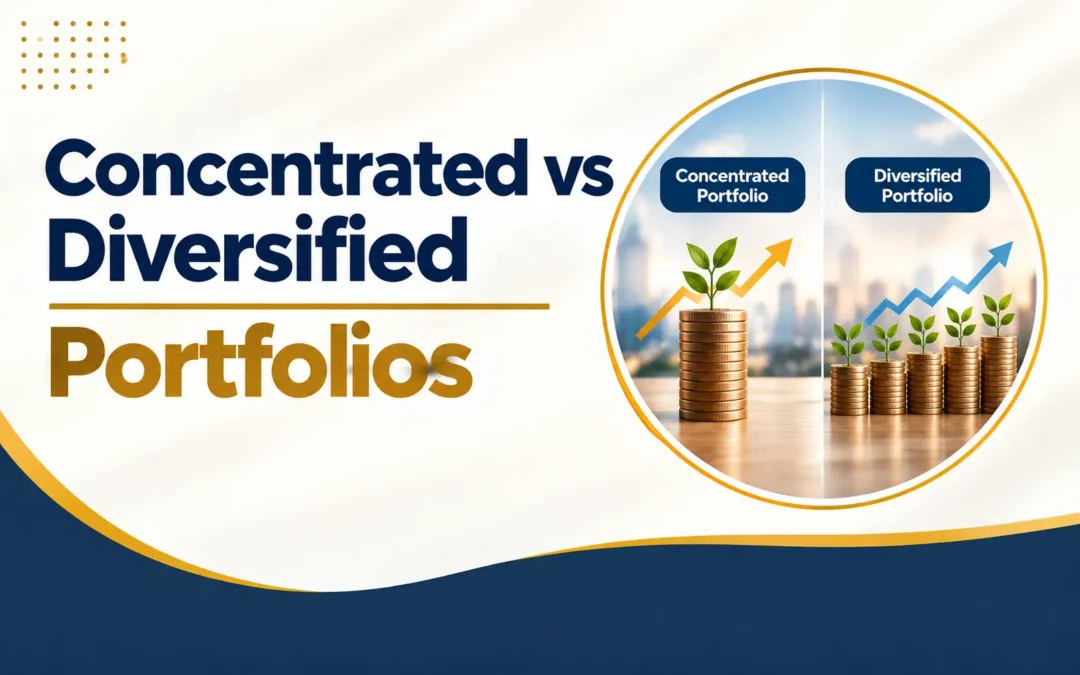
Diversification is sold as risk management. Past a point, it mostly manages the manager’s career risk. Research shows 15 to 20 stocks eliminate most unsystematic risk; every addition after that barely cuts volatility while diluting high-conviction ideas. In India, with quality varying hugely across 5,000+ listed companies, concentration in the right businesses compounds faster than diversification across the wrong ones. The real question is whether the manager has the research depth to run a concentrated book without being reckless.
According to the investment team at Chanakya Capital, a SEBI-registered portfolio manager, “owning 60 stocks in India isn’t diversification; it’s confusion. You can’t have genuine conviction on 60 businesses simultaneously, which means 40 of them are in the portfolio for reasons that have nothing to do with expected return.”
Paying active management fees on a portfolio that looks suspiciously like the index?
Why Does Concentration Outperform Diversification in Indian Equity?
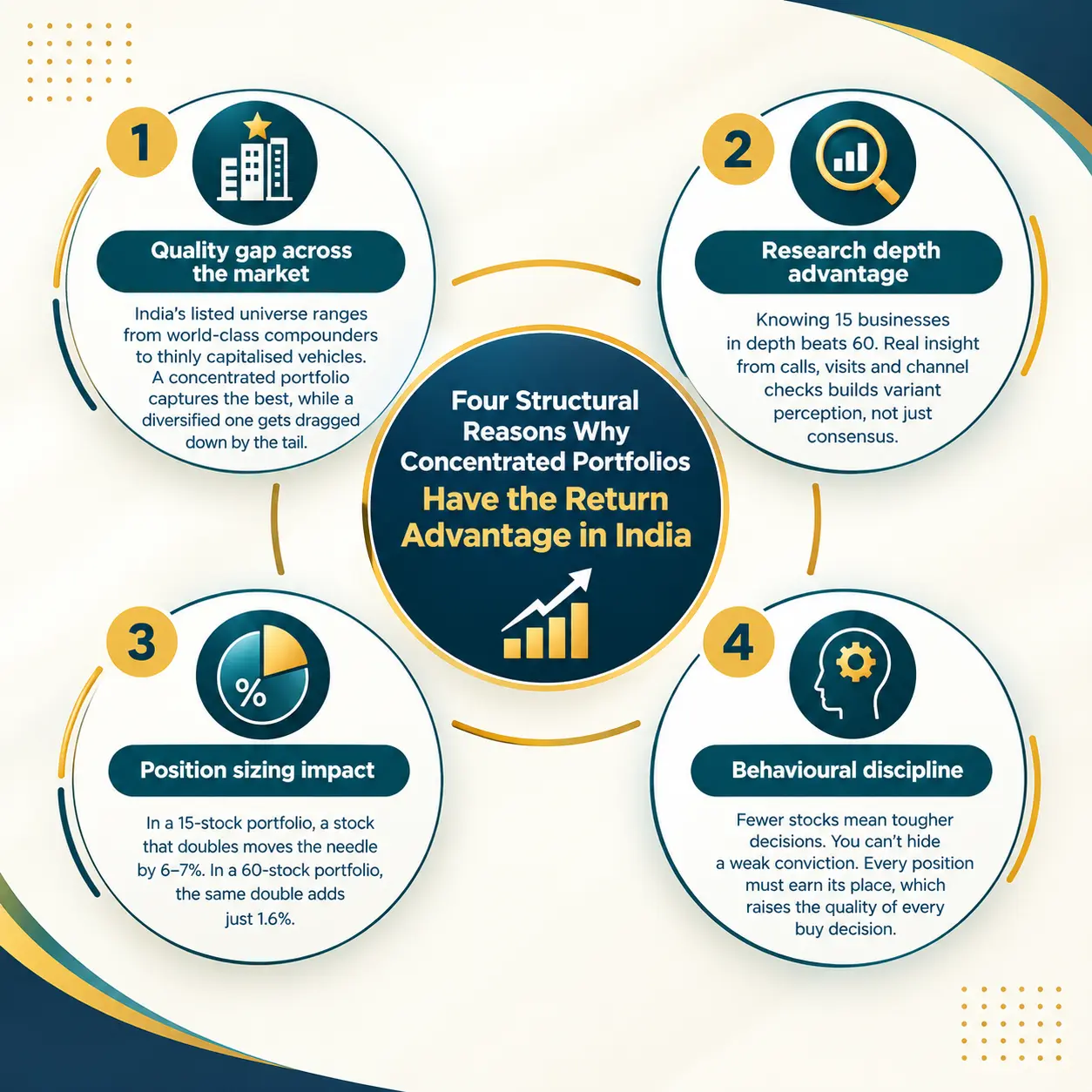
Concentration isn’t recklessness. It’s the natural consequence of having genuinely high conviction on a small number of well-researched businesses and in Indian equity, that’s where the alpha has consistently lived. See how Chanakya Capital’s concentrated process is built around genuine conviction
When Does Diversification Make Sense in Indian Portfolios?
Four situations where diversification is the right structure, not a compromise:
- Corpus size: A ₹500 crore fund holding 15 mid- and small-cap stocks creates real market impact on entry and exit, so it must diversify. An HNI with ₹1 to 5 crore in a PMS faces no such limit and can run concentrated.
- Sector uncertainty: When a sector is in transition (regulation, disruption, commodity inflection), spreading across several players cuts the risk of backing the wrong survivor. This is tactical diversification within a thesis, not a default.
- Early-stage investors: An investor who doesn’t yet trust a concentrated manager may exit in a 25% drawdown and lock in a permanent loss. Lower volatility is the right structure until that trust builds.
- Multi-asset allocation: Spreading across equity, debt, real estate and alternatives genuinely reduces risk, unlike spreading within equity. A concentrated PMS plus a Category II AIF and fixed income is diversified at the portfolio level without diluting equity alpha.
So the answer isn’t one or the other permanently. It depends on the manager’s research capacity, the investor’s corpus and temperament, and how equity fits the wider portfolio, which is what HNIs split between PMS and AIF covers at the allocation level.
Why Choose Chanakya Capital?
Chanakya Capital Services Pvt. Ltd. is a SEBI-registered portfolio manager (INP000006040) running 12 to 18 stock-concentrated equity portfolios for HNIs, NRIs, and family offices through onshore PMS and a Category III AIF at GIFT City IFSC. Every position has a written thesis, a DCF with sensitivity analysis behind it, and a cash flow quality filter applied before valuation work begins. The top 5 positions typically carry 40 to 50% of the portfolio weight because that’s where the conviction is highest and the return contribution should be largest.
The firm stays deliberately small. Concentration and speed of action are the edge both erode with scale. Every client gets the same portfolio the principals run for themselves. No dilution, no benchmark tracking, no position that exists because it’s too risky not to own.
FAQ
Frequently Asked Questions
How many stocks should a concentrated equity portfolio hold in India?
Research suggests 15 to 20 stocks eliminate most unsystematic risk; beyond that, additional stocks add comfort but not meaningful risk reduction.
Does a concentrated portfolio always outperform a diversified one?
Only when the manager has genuine research depth and conviction; concentration amplifies both skill and error, so manager quality is the critical variable.
Is a concentrated PMS riskier than a diversified mutual fund?
Volatility is higher, but permanent capital loss risk depends on business quality and manager process, not stock count.
Can HNIs hold a concentrated equity PMS alongside other asset classes?
Yes, concentration within the equity sleeve combined with diversification across asset classes is the structure most sophisticated HNI portfolios use.