

HNI Investors By Chanakya Capital
High Net-Worth Individuals (HNIs) have needs that standard retail products rarely address, larger pools of capital, more complex tax situations, and a lower tolerance for one-size-fits-all solutions. Chanakya Capital works with HNI investors through concentrated, research-driven PMS and AIF strategies, built around the reality that managing significant wealth requires more customisation, transparency, and direct access than a mutual fund folio can offer.
Most HNI investors already hold a mix of real estate, fixed income, business interests, and some equity exposure. What’s often missing is a dedicated, high-conviction equity allocation managed by a team that treats their portfolio as distinct from everyone else’s, not a slightly larger version of a retail product.
That distinction shows up most clearly in how decisions get made. A retail mutual fund is built for thousands of investors with different goals and has to compromise toward the average. An HNI portfolio, by contrast, can be built around one investor’s specific tax situation, liquidity timeline, and conviction level which is precisely what PMS and AIF structures are designed to allow.
Looking for a wealth strategy built around your specific situation?
What Sets HNI Investing Apart
NRIs can access Chanakya Capital’s strategies through a few routes, depending on their residency status and investment preference:
Larger, More Concentrated Allocations With meaningful capital to deploy, HNI investors can access concentrated strategies, PMS and AIF structures that aren’t available at smaller ticket sizes, allowing for genuine conviction-driven investing rather than broad diversification alone.
Tax and Structuring Complexity Capital gains treatment, demat-based taxation, and the choice between PMS and AIFstructures all have real tax implications that matter more as portfolio size grows.
Direct Access to Decision-Makers HNI investors typically expect to speak with the person actually managing their money, not a relationship manager relaying updates secondhand, a standard boutique PMS houses are built around.

How Chanakya Capital Serves HNI Investors
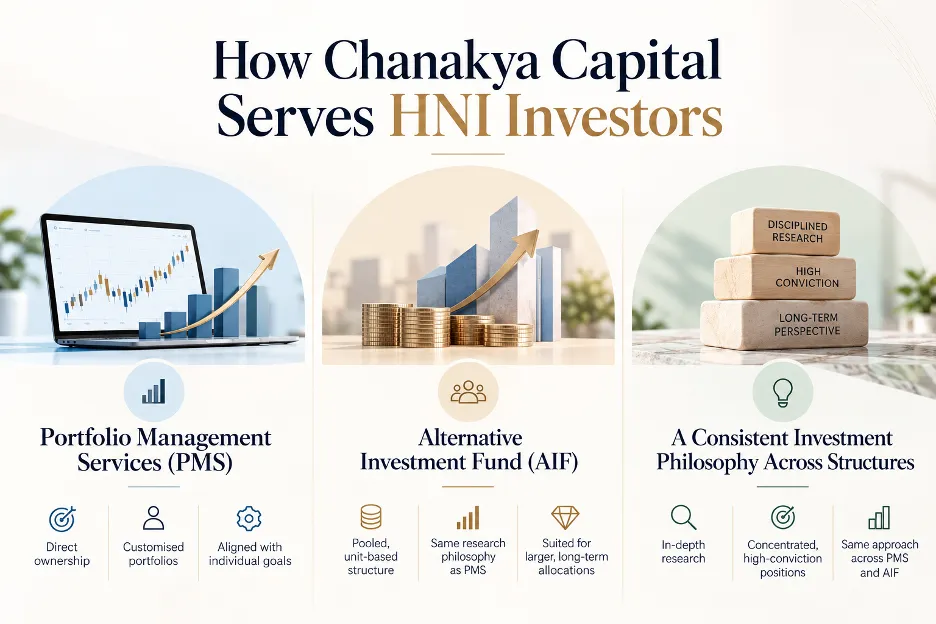
Portfolio Management Services (PMS)
A Consistent Investment Philosophy Across Structures
Whether through PMS or AIF, the underlying approach doesn’t change, concentrated, high-conviction positions identified through in-depth research. Investment philosophy explains how this plays out across both vehicles.
What HNI Investors Should Evaluate Before Committing
Portfolio size alone doesn’t determine which structure or strategy fits. HNI investors should weigh liquidity needs, existing asset allocation, risk appetite for concentrated equity exposure, and whether they want individual account visibility (PMS) or pooled, simplified reporting (AIF). It’s also worth considering how much of the broader portfolio is already tied up in illiquid assets like real estate or private business interests, since that often shapes how much concentration risk makes sense within the equity allocation itself. Our guide to the minimum investment for PMS is a useful starting point for understanding how the ₹50 lakh threshold is assessed and funded.
Due Diligence Still Matters at Every Wealth Level
A larger ticket size doesn’t reduce the need for due diligence, if anything, it raises the stakes. Every HNI investor should independently verify a manager’s SEBI registration before committing capital, understand the fee structure in detail, and review how gains will be taxed. SEBI’s investor guidance is a useful reference on disclosure norms, and the Income Tax Department provides authoritative detail on how capital gains from equity and PMS investments are taxed.
Ready to build a wealth strategy suited to where you are today?
FAQ
Frequently Asked Questions
1. Who counts as a high-net-worth (HNI) investor?
There’s no universal definition, but the global benchmark is investable wealth of roughly US30 million. What matters more than the label is that at this level, investors need strategies built around their specific goals, not off-the-shelf products.
2. Managed account or pooled fund: which suits an HNI investor better?
Think of it as ownership versus convenience. A managed account (PMS-style, or SMA) puts the securities in your name, with full transparency into every holding and trade. A pooled fund (AIF-style) trades some of that visibility for a unit-based structure, often with a higher minimum ticket. If you want to see and control what you own, choose the first. If you prefer a simpler, consolidated structure, choose the second.
3. Does Chanakya Capital offer both options?
Yes. Both are built on the same concentrated, research-led philosophy: a small number of high-conviction ideas, not a long list of safe bets. Only the wrapper differs, so you can pick the structure that fits how you like to invest without changing the thinking behind your portfolio.
4. How are gains taxed in a managed account?
Because the securities sit directly in your own account, gains are generally treated as if you had bought the stocks yourself, so your usual capital gains rules apply. Pooled funds can be taxed differently depending on how they’re structured. Rates and rules vary widely by country, so check with a tax advisor in your jurisdiction before choosing a structure.
5. Why do HNI investors choose concentrated strategies over mutual funds?
Mutual funds are built to serve thousands of investors at once, which means broad diversification and a one-size-fits-all approach. Concentrated strategies flip that: portfolios can be tailored to you, your manager is accessible, and each position is a genuine conviction, not a filler. For investors who want their wealth to work harder, not just stay average, that difference matters.
References:
SEBI Investor Guidance — Portfolio Management Services: https://investor.sebi.gov.in/pms_final.html
Income Tax Department, Government of India: https://www.incometax.gov.in