
Portfolio design is arguably the single biggest driver of outcomes in Portfolio Management Services (PMS). Unlike a mutual fund, where thousands of investors share one standard basket, a PMS portfolio is built stock by stock around a manager’s philosophy, concentration limits, and risk framework. Weak design shows up as unexplained volatility, poor diversification within a theme, or returns that depend on one lucky pick. Strong design shows up as a portfolio that behaves predictably through different market phases, even when individual stocks move unpredictably.
Most PMS marketing leads with past returns. Few investors ask the more useful question first: how was this portfolio actually built, and why does it look the way it does? That answer tells you far more about what to expect going forward than a trailing three-year return ever will.
According to the team at Chanakya Capital, a SEBI-registered portfolio manager, “Two managers can post similar returns over a year and arrive there completely differently, one through disciplined design, the other through a single stock that happened to work. Only one of those is repeatable.”
What Portfolio Design Actually Covers
Stock Selection Criteria:
Every manager works from a filter — quality of business, valuation discipline, growth potential, or a mix of these. Design starts with how consistently that filter is applied, not just which stocks pass it.
Concentration and Position Sizing:
A PMS portfolio typically holds 15–25 stocks, but how much weight each position carries matters as much as the stock count. Even sizing spreads risk; a few oversized bets can quietly turn a “concentrated” portfolio into a single-stock bet.
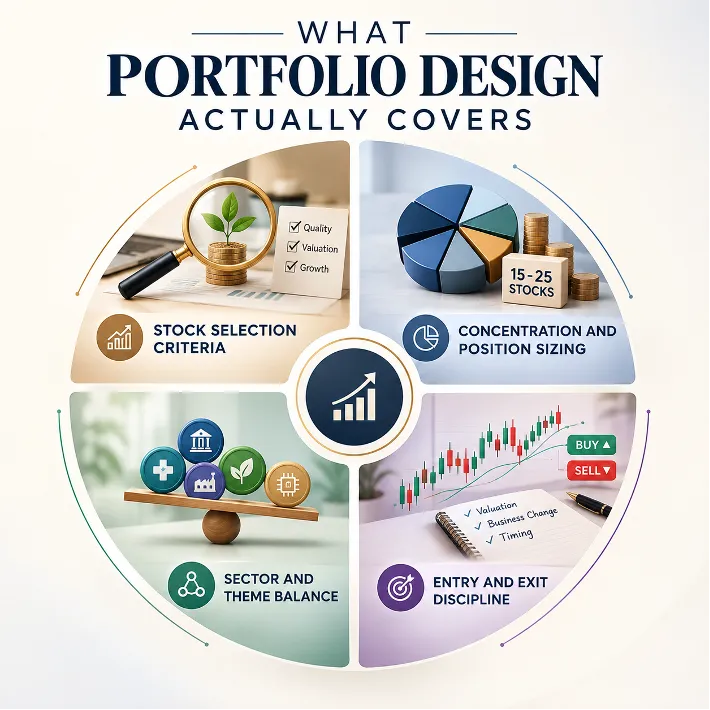
Sector and Theme Balance:
Good design avoids unintentional overlap, multiple stocks that all move together because they share the same sector or macro driver, which defeats the purpose of holding 15–25 names in the first place.
Entry and Exit Discipline:
Some managers use a proprietary timing framework to decide when to build or trim a position, rather than buying once and holding indefinitely regardless of valuation or business change.
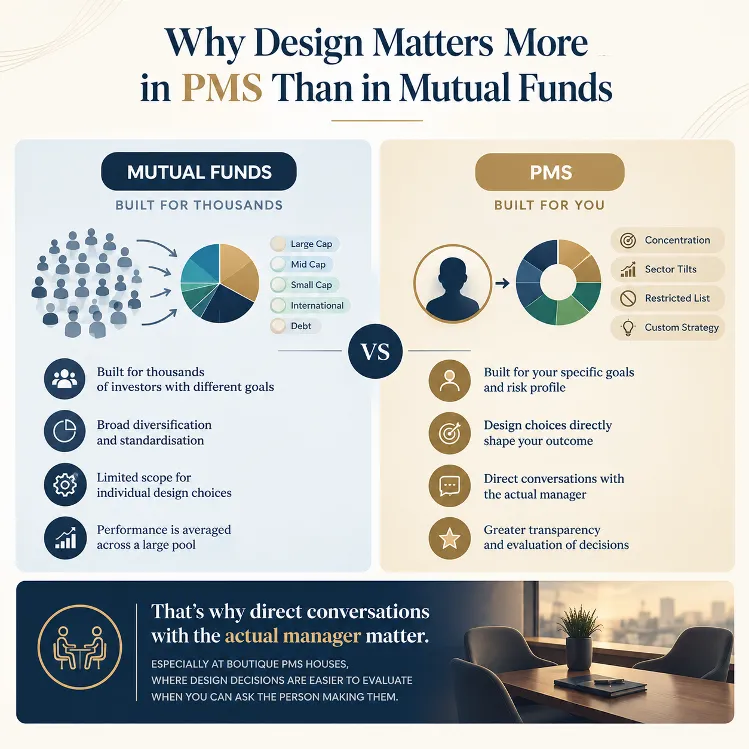
Why Design Matters More in PMS Than in Mutual Funds
A mutual fund’s portfolio is built for thousands of investors with different goals, which pushes it toward broad diversification and standardisation. A PMS portfolio is built for you, which means design choices — concentration, sector tilts, restricted stock lists, directly shape your outcome rather than being averaged out across a large pool. This is also why direct conversations with the actual manager, common at boutique PMS houses, matter: design decisions are easier to evaluate when you can ask the person making them. See how Chanakya Capital’s investment philosophy translates into these design choices in practice.
The Risk Side of Portfolio Design
Most investors focus on the return prospects of individual stocks and much less on the risk of the overall portfolio. Yet a diligent portfolio architecture can deliver a lower level of risk for a given expected return. That is where covariance comes in.
Why Covariance Matters: Covariance describes how stocks move in relation to one another. When holdings don’t all move together, the swings of one position are partly offset by others, and overall portfolio risk comes down. Understanding this helps a fund manager significantly improve the risk–return prospects of a well-designed portfolio, beyond what picking good stocks alone can achieve.
Customised vs Pooled Portfolios: The difference shows up most clearly when you compare structures:
- Pooled portfolio: every investor faces the same risk–return trade-off, because everyone holds the same basket.
- Chanakya PMS: each investor receives a customized portfolio, which can help further improve return and reduce risk for that individual.
In-House Mathematical Optimisation: To make this practical, we use an in-house mathematical optimisation process to fine-tune and automate portfolio construction for our investors, so that the design principles above are applied consistently across accounts.
Signs a Portfolio Is Well-Designed
A well-designed portfolio holds up in ways you can actually observe: returns aren’t dependent on one or two outsized winners, sector exposure is deliberate rather than accidental, position sizes reflect conviction rather than habit, and the manager can explain why each stock earned its place. Our Portfolio Management Services covers how these principles come together in a concentrated equity strategy.
Questions to Ask Before You Judge a Portfolio on Returns Alone
Before comparing trailing performance across managers, ask how the portfolio is structured: What’s the largest single position as a percentage of the portfolio? How many stocks account for most of the return? Is the manager SEBI-registered and in good standing — a detail worth checking against the SEBI registered PMS list before you go further. These questions surface design quality faster than any return chart can.
Hear From Our CIO
At Chanakya, we invest your money for the long term, at reasonable valuations and with a high margin of safety. All of this we have learnt over time, by living through very diverse and creative experiences. Our CIO, Rajesh Tiwari, shares some of these experiences and learnings in two recent podcasts:
Enjoy the essence of our education in these. We would be glad to hear your thoughts on the podcasts, and you can share them with our team.
FAQ
Frequently Asked Questions
Why does portfolio design matter more than past returns?
Past returns reflect what already happened, often shaped by a few stocks. Design reflects how repeatable that outcome is likely to be going forward.
How many stocks should a well-designed PMS portfolio hold?
Most concentrated PMS strategies hold 15–25 stocks, enough for meaningful diversification without diluting conviction on the best ideas.
What's the risk of poor position sizing in a PMS portfolio?
Uneven sizing can turn a portfolio that looks diversified on paper into one where a single stock drives most of the outcome, positive or negative.
Does sector concentration matter even with 20+ stocks?
Yes. Holding many stocks in the same sector or theme can behave like a single concentrated bet, even if the stock count suggests otherwise.
How can I evaluate a manager's portfolio design before investing?
Ask for position sizing, sector breakdown, and the rationale behind each holding, and verify the manager’s SEBI registration through official sources.
References
- SEBI Investor Guidance — Portfolio Management Services: https://investor.sebi.gov.in/pms_final.html
- Association of Portfolio Managers in India (APMI): https://apmiindia.org