


Investing in PMS isn’t as simple as opening a mutual fund folio. It needs a larger capital commitment and comfort with a concentrated, market-linked portfolio but done right, it offers customisation and transparency pooled products can’t match.
According to the team at Chanakya Capital, a SEBI-registered portfolio manager, “Most investors approach PMS the way they approach mutual funds, comparing past returns and moving on. The better question is whether the manager’s philosophy, concentration, and risk discipline actually match how you think about money.”
What to Expect in Your First Few Weeks
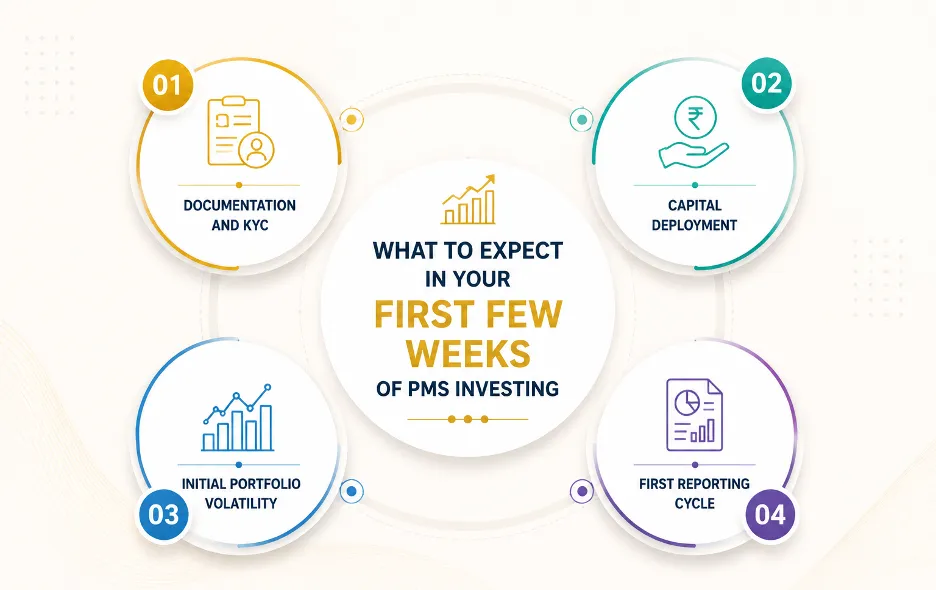
KYC and the Portfolio Management Agreement usually take a few days to a couple of weeks. Your ₹50 lakh (or more) is rarely invested all at once, managers deploy it gradually. With 15–25 stocks, early performance can look more volatile than a mutual fund; that’s expected, not a red flag. Your first detailed statement usually arrives within a month, reflecting a portfolio still being built. NRI investors face a few extra regulatory steps. Learn more about PMS for NRIs.
Financial, Strategic, and Practical Considerations

Strategic: Concentration (each position carries real weight), customisation (restricted lists, sector tilts, goal-based tweaks), proprietary market-timing used by some managers, and direct manager access at boutique houses.
Financial and Practical: Taxation mirrors direct equity — 12.5% LTCG beyond ₹1.25 lakh, 20% STCG. Fees are typically fixed plus a performance fee above a hurdle rate. Most strategies carry no exit load, though illiquid stocks can slow an exit, and every transaction is visible in real time — unlike mutual funds’ periodic disclosures.
See how Chanakya Capital’s investment philosophy shapes portfolio construction. Related reading: our Portfolio Management Services explains how a concentrated equity strategy is built and managed.
The Full List: 10 Steps to Investing in PMS in India
2. Confirm you meet the ₹50 lakh minimum.
3. Shortlist SEBI-registered managers with a clean compliance record.
4. Review each manager’s philosophy and concentration.
5. Compare fee structures — fixed, performance-linked, or hybrid.
6. Ask for fee-adjusted historical performance.
7. Schedule a consultation to discuss fit.
8. Complete KYC, demat linking, and the Agreement.
9. Fund the account; let the manager deploy capital gradually.
10. Track your portfolio through regular reviews.
Skipping the diligence steps is usually where regret comes from later.
Investment Timeline: What Happens When
Onboarding and portfolio maturity follow a broad pattern, though the pace varies with your documentation readiness, the manager’s deployment approach, and market conditions. This table gives a realistic sense of the journey rather than a fixed schedule.
| Timeframe | What Can Happen | What It Usually Means |
| Week 1–2 | KYC, documentation, demat linking | Standard onboarding, managed alongside the provider’s team |
| Week 2–4 | Gradual capital deployment begins | Manager building positions per strategy and market timing |
| Month 1–3 | Portfolio volatility, first statements | Normal for a newly concentrated portfolio to settle |
| 1–3 years | Strategy performance becomes evaluable | Enough of a cycle to judge manager discipline and process |
| 3+ years | Long-term compounding takes shape | The horizon PMS is genuinely designed for |
When Should You Reassess Your PMS Investment?
Why Investor Outcomes Vary in PMS
Why Choose Chanakya Capital for PMS in India?
Chanakya Capital Services is a SEBI-registered portfolio manager (Reg. No. INP000006040) built on a first-principles, concentrated equity strategy, backed by a core team with 35+ years of combined market experience. Using in-depth research and a proprietary timing framework, the team identifies high-conviction businesses, including turnaround opportunities larger PMS houses often overlook. Founders invest alongside clients, and Chanakya Capital also offers a GIFT City-approved offshore gateway for NRIs and international investors seeking USD-denominated access to Indian equities with simplified taxation and repatriation.
FAQ
Frequently Asked Questions
1. What is the minimum amount required to invest in PMS in India?
2. Can NRIs invest in PMS in India?
3. How is PMS different from mutual funds?
4. What returns can I expect from a PMS?
5. How are PMS investments taxed in India?
6. What type of risk would you be taking by investing through the given PMS?
7. What is the portfolio churn rate? Would a lower churn rate effectively reduce the tax disadvantage compared with mutual funds?
8. Does the portfolio manager have any "skin in the game" in the portfolio?
9. Does the portfolio have character in the stock and portfolio contribution?
References
- SEBI Investor Guidance — Portfolio Management Services: https://investor.sebi.gov.in/pms_final.html
- Groww — Portfolio Management Services in India: https://groww.in/blog/portfolio-management-service
