

A DCF values a business by discounting its future free cash flows to today’s money. It’s the most rigorous valuation method and the most abused. Get the growth rate off by 2%, the discount rate wrong, or terminal value misread, and the output can swing 40%. In India, where earnings visibility is low and accounting quality is mixed, a DCF is only as good as your understanding of the business. This guide covers the mechanics and where models break.
According to the investment team at Chanakya Capital, a SEBI-registered portfolio manager, “a DCF is not a valuation tool; it’s a thinking tool. The number it produces is almost always wrong. What matters is understanding why it’s wrong and in which direction.”
Building a DCF on an Indian stock and unsure whether your assumptions are realistic?
How Do You Build a DCF Model for an Indian Stock?
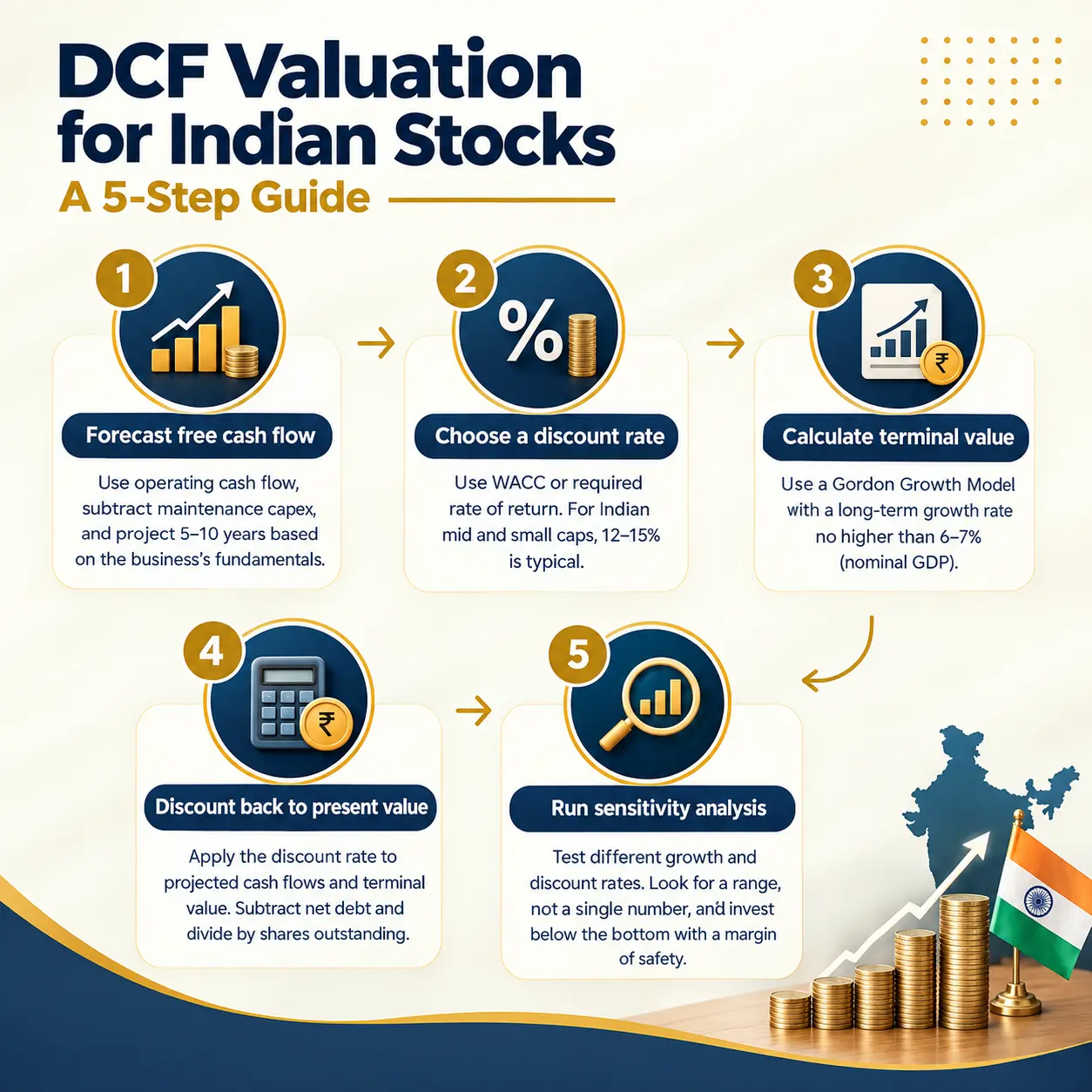
A DCF built without sensitivity analysis is just a number that looks precise. It isn’t. See how Chanakya Capital applies valuation discipline in its stock selection process.
Where Do DCF Models Break Down for Indian Stocks?
Four failure points specific to Indian equity analysis:
- Promoter behaviour: Related-party transactions, excessive salaries, or holding-company structures can drain the free cash flow your model discounts. Assess governance before building the DCF.
- Terminal value sensitivity: In most Indian DCFs, 70%+ of value sits in terminal value, and a 1% change in terminal growth moves intrinsic value 20 to 30%. It’s set last and stress-tested least.
- Capex classification: Companies have wide latitude in labelling growth versus maintenance capex. Using total capex understates free cash flow for growing businesses and overstates it for those with a deteriorating asset base.
- Accounting quality: A DCF built on reported earnings without checking cash conversion models fiction. If only 50% of earnings convert to free cash flow, the inputs must reflect that.
These are standard failure modes, not edge cases. That’s why a good cash flow analysis has to precede any DCF model, not follow it.
Why Choose Chanakya Capital?
Chanakya Capital Services Pvt. Ltd. is a SEBI-registered portfolio manager (INP000006040) running concentrated listed equity portfolios for HNIs, NRIs, and family offices through onshore PMS and a Category III AIF at GIFT City IFSC. Every position in the portfolio has a DCF model behind it built from unit economics, stress-tested across scenarios, and reviewed against actual cash flow conversion before a buy decision is made.
The team doesn’t use DCF to generate a precise intrinsic value. It uses it to understand the range of outcomes the business can produce, identify which assumptions drive the most value, and size the position according to how confident those assumptions are. That’s the difference between valuation as a discipline and valuation as a justification.
FAQ
Frequently Asked Questions
What is DCF valuation in simple terms?
A method of valuing a stock by estimating future free cash flows and discounting them back to today’s value using a required rate of return.
What discount rate should I use for Indian stocks?
Most Indian equity analysts use 12 to 15% for mid and small caps, higher than developed market peers to account for volatility, governance risk, and liquidity premium.
Why does terminal value matter so much in a DCF?
Terminal value typically represents 60 to 80% of the total DCF output small changes in the terminal growth rate assumption have an outsized impact on the intrinsic value result.
What is a margin of safety in DCF valuation?
Buying at a price meaningfully below the bottom of the DCF’s intrinsic value range the gap protects against errors in assumptions, which are inevitable in any long-range forecast.