

A PMS track record means nothing if you only look at the headline return. Two managers can show 18% CAGR over five years one through a disciplined process, the other through leverage and lucky sector bets that dropped 60% before recovering. The number looks identical. The risk taken to produce it doesn’t. Evaluating a PMS properly means examining drawdown behaviour, portfolio construction, cycle consistency, benchmark relevance, and fee alignment.
According to the investment team at Chanakya Capital, a SEBI-registered portfolio manager, “most investors compare PMS managers the way they compare fixed deposits by the rate. But a PMS return without its drawdown profile is like a speed record without mentioning the number of crashes.”
Reviewing a PMS manager’s track record and unsure what the numbers are actually telling you?
What Should You Look At Before the Return Number?
Four things that tell you more about a PMS manager than CAGR ever will:
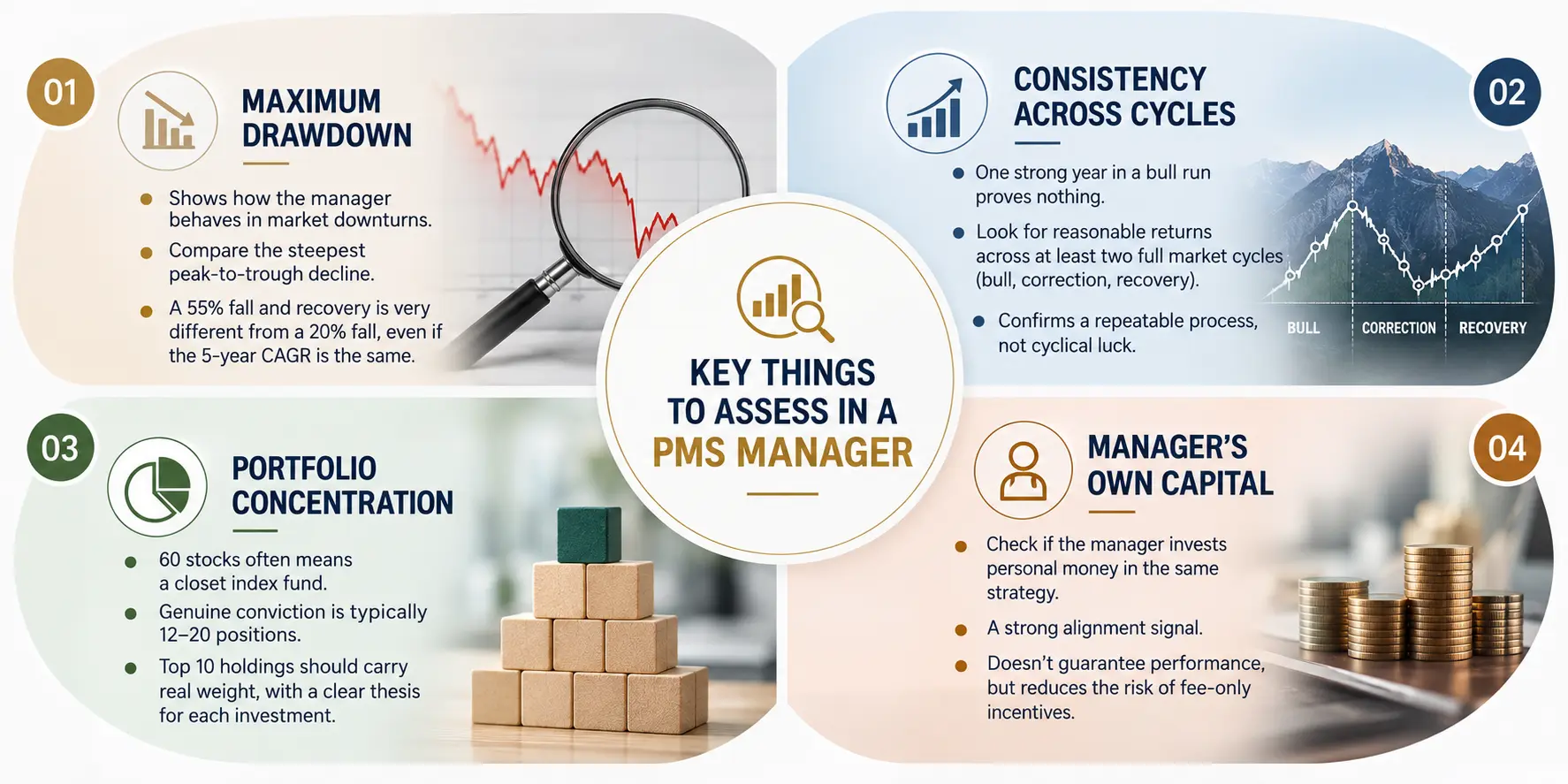
These four tell you whether the track record reflects a process or a period. A process survives market cycles. A period doesn’t. See how Chanakya Capital’s investment process is built around conviction, not diversification.
What Else Gets Missed When Evaluating a PMS?
Four operational factors most investors never check:
- Benchmark relevance: A PMS benchmarking against a small-cap index while holding large-caps is obscuring underperformance. The right benchmark matches the actual investment universe if a manager resists stating one clearly, that’s the answer.
- Fee structure: A 2% management fee plus 20% performance fee sounds standard but check whether the hurdle resets annually or carries forward losses. A manager charging performance fees after a bad year followed by recovery is extracting profit on returns that didn’t make the investor whole.
- Audited vs unaudited returns: SEBI requires PMS managers to report returns, but not all are third-party audited. Ask specifically whether returns are TWRR or XIRR, net of fees, and verified by an independent auditor rather than calculated internally.
- Client retention: High churn in a PMS showing strong returns usually means the client experience doesn’t match the marketing through poor communication, unexpected drawdowns, or a portfolio that looks nothing like what was pitched.
Asking the right questions only helps if the manager answers them without deflecting. A manager who can’t explain their process clearly probably doesn’t have one worth trusting. That’s where first-principles investing separates itself from managers who hide behind minimum investment thresholds and regulatory compliance as a substitute for process.
Why Choose Chanakya Capital?
Chanakya Capital Services Pvt. Ltd. is a SEBI-registered portfolio manager (INP000006040) running a concentrated listed equity PMS and a Category III AIF at GIFT City IFSC for HNIs, NRIs, and family offices. The portfolio runs 12 to 18 stocks, the top positions carry genuine sizing, and the fund managers invest their own capital alongside every client. Track record, drawdown history, and portfolio construction are shared transparently no composite blending, no benchmark switching.
The firm’s approach is built on one constraint: only own businesses you’d be comfortable holding through a 40% market drawdown. That filters the portfolio down to companies with real earnings, real cash flows, and management that allocates capital honestly. It doesn’t eliminate volatility but it eliminates the kind of permanent capital loss that a poorly constructed PMS produces when the cycle turns.
FAQ
Frequently Asked Questions
What is a good maximum drawdown for a PMS?
Under 30% in a severe market correction is generally acceptable for an equity PMS with strong long-term returns.
Should PMS returns be compared to Nifty 50?
Only if the PMS invests primarily in large-caps; the benchmark must match the actual investment universe.
What is the difference between TWRR and XIRR in PMS reporting?
TWRR measures portfolio performance independent of cash flows; XIRR accounts for the timing of investor contributions and withdrawals.
Is a PMS with 60 stocks better than one with 15?
No, a higher stock count usually means lower conviction and index-like returns without the lower cost of an index fund.
