


Most investors treat the ₹50 lakh figure as a simple entry ticket. In reality, how the money is funded, whether it needs to stay above the line later, and what the rule is actually protecting you from are worth understanding before you sign on.
According to the team at Chanakya Capital, a SEBI-registered portfolio manager, “The ₹50 lakh minimum isn’t a fee or a hurdle, it exists so PMS stays a product for investors who understand concentrated equity risk and can stay invested through a full market cycle.”
How the ₹50 Lakh Minimum Can Be Funded
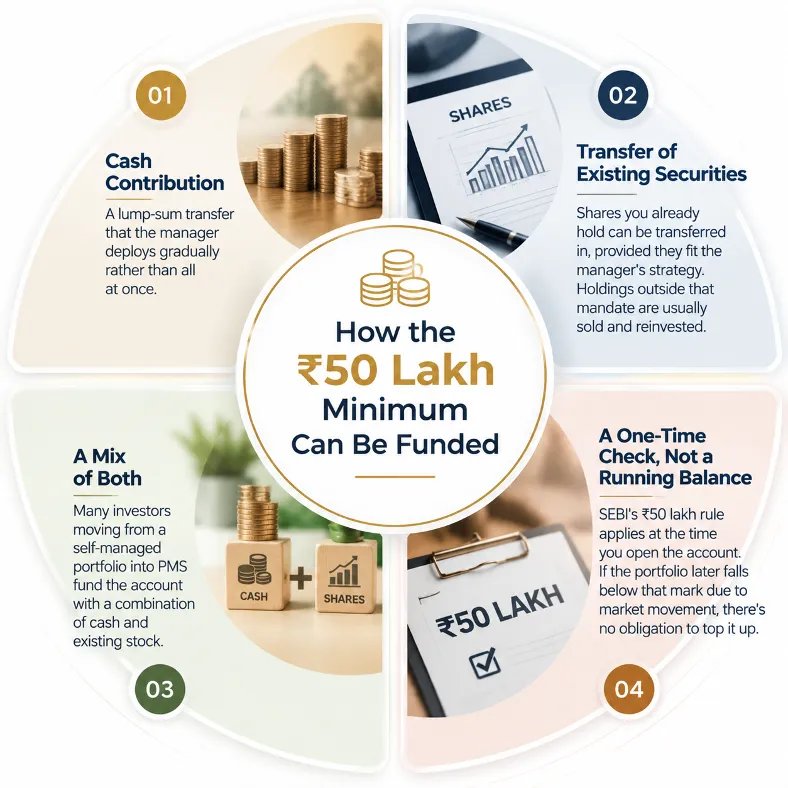
Cash Contribution:
The simplest route, a lump-sum transfer that the manager deploys gradually rather than all at once.
Transfer of Existing Securities:
Shares you already hold can be transferred in, provided they fit the manager’s strategy. Holdings outside that mandate are usually sold and reinvested.
A Mix of Both:
Many investors moving from a self-managed portfolio into PMS fund the account with a combination of cash and existing stock.
A One-Time Check, Not a Running Balance:
SEBI’s ₹50 lakh rule applies to the value of your account at the time it’s opened. If the portfolio later falls below that mark purely due to market movement, there’s no obligation to top it up — though most managers suggest staying near the threshold for the strategy to work as designed.
Why This Threshold Exists
The rule is SEBI’s way of separating PMS from mass-market products like mutual funds. A 15–25 stock portfolio moves more sharply than a diversified fund, and the ₹50 lakh floor ensures investors have the financial cushion to sit through that volatility without needing the money for near-term goals. It’s also what allows a manager to build a genuinely personalised portfolio instead of a standardised one, a principle at the core of Chanakya Capital’s investment philosophy.
Does the Minimum Change for NRIs or Family Accounts?
NRIs meet the same ₹50 lakh requirement, typically through NRE or NRO accounts, and can also access GIFT City-approved, USD-denominated structures. If you’re investing from abroad, it’s worth reading how PMS for NRIs works before starting the process. For families, the threshold is generally applied per PAN, each individual investor needs to independently meet ₹50 lakh unless the account sits under a shared structure like a HUF or trust.
PMS vs Mutual Funds vs AIFs: Where the Minimum Fits
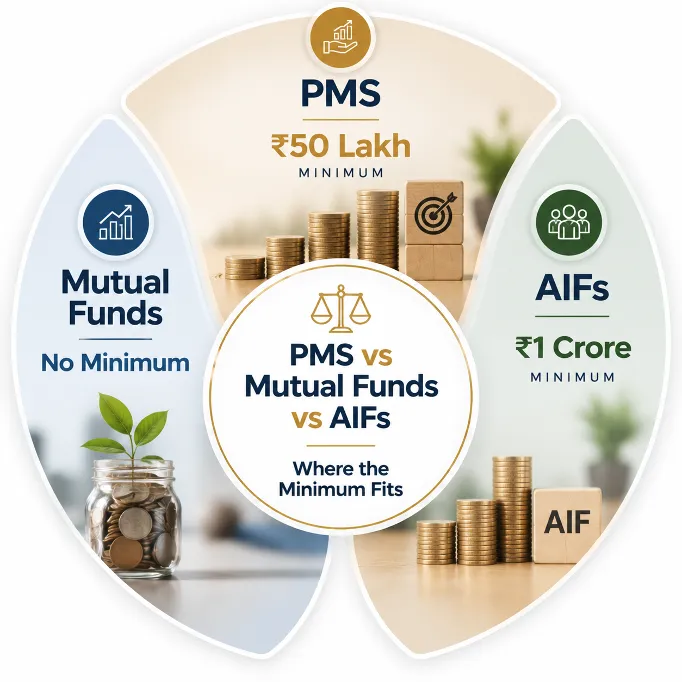
Mutual funds carry no entry minimum, which is why they remain the most accessible route for retail investors. At the other end, AIFs require a much steeper ₹1 crore commitment. PMS sits in between, a serious equity allocation without the higher barrier of an AIF. Our guide to Portfolio Management Services breaks down how concentration and customisation set PMS apart from both.
What Comes After You Meet the Minimum
Clearing ₹50 lakh only gets you in the door. From there, the real work is choosing a SEBI-registered manager, understanding their strategy and fee structure, and completing KYC and documentation. Before committing, it’s worth reviewing SEBI’s investor guidance on disclosure norms, and checking a manager’s standing with the Association of Portfolio Managers in India, which maintains the industry’s registry of licensed portfolio managers.
FAQ
Frequently Asked Questions
1. What is the minimum investment required for PMS in India?
2. Can I start a PMS account with less than ₹50 lakh?
3. Does the ₹50 lakh rule apply to each stock or the whole portfolio?
4. What if my portfolio value drops below ₹50 lakh after I've invested?
5. Do NRIs need to meet a different minimum for PMS?
References
● SEBI Investor Guidance — Portfolio Management Services: https://investor.sebi.gov.in/pms_final.html
● Association of Portfolio Managers in India (APMI): https://apmiindia.org
