

Alternative Investment Fund (AIF) By Chanakya Capital
An Alternative Investment Fund (AIF) is a privately pooled investment vehicle, regulated by SEBI, that gives investors access to strategies beyond traditional stocks, bonds, and mutual funds. At Chanakya Capital, the AIF runs on the same research-driven, concentrated equity philosophy behind our PMS offering, structured instead as a pooled fund, which suits investors who prefer a simpler, unit-based way to invest alongside others who share the same strategy.
Where PMS gives you a directly-owned, individually managed portfolio, an AIF pools capital from multiple investors into a single fund, with each investor holding units rather than the underlying stocks themselves. The investment decisions, research process, and conviction behind the portfolio stay the same only as the structure changes.
For many investors, the appeal of an AIF isn’t a different philosophy but a simpler way to access one: fewer individual decisions to track, consolidated reporting, and a structure built for investors who are comfortable delegating both the stock selection and the account-level administration to the manager.
Curious whether an AIF or PMS structure fits your investing style?
Get in touch with Chanakya Capital’s fund management team.
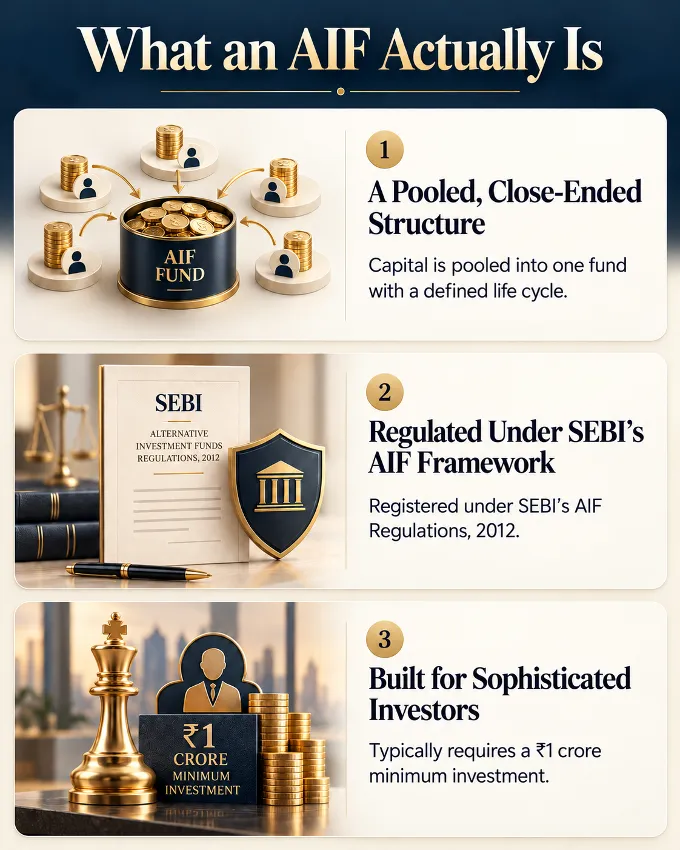
What an AIF Actually Is
A Pooled, Close-Ended Structure: Capital from multiple investors is combined into a single fund with a defined life cycle, rather than remaining in individual accounts. Units are issued against this pooled corpus.
Regulated Under SEBI’s AIF Framework: Every AIF must register under the SEBI (Alternative Investment Funds) Regulations, 2012, which classifies funds into Category I, II, or III based on their investment focus and strategy.
Built for Sophisticated Investors: AIFs carry a significantly higher entry threshold than PMS typically ₹1 crore reflecting the expectation that investors understand the strategy’s risk and illiquidity before committing.
How Chanakya Capital’s AIF Is Structured
Category III Strategy Chanakya Capital’s AIF falls under Category III, which permits diverse or complex trading strategies, including the use of listed derivatives, while still anchored to fundamental research rather than purely algorithmic trading.
Same Philosophy, Different Vehicle The fund applies the same first-principles stock selection and proprietary timing framework used across Chanakya Capital’s strategies. You can read more about the thinking behind this approach in investment philosophy.
Alignment Through Co-Investment As with our PMS, the founders invest alongside fund investors rather than running a separate book, keeping incentives aligned across both structures.
Fee Structure AIFs typically carry a management fee alongside a performance fee above a hurdle rate, broadly similar in principle to PMS fee structures, though the specific terms are set out in the fund’s private placement memorandum.

AIF vs PMS: Choosing the Right Structure
The right structure depends on how involved you want to be. PMS gives you direct ownership, full transaction-level visibility, and a portfolio built specifically around your account. An AIF offers a simpler, unit-based experience with pooled reporting, often appealing to investors who want exposure to the same strategy without managing an individual portfolio. If you’re weighing the two, our overview of Portfolio Management Services is a useful comparison point, and our guide to the minimum investment for PMS explains how that threshold compares with an AIF’s higher entry point.
Risk, Liquidity, and Who Should Consider an AIF
AIFs are close-ended and carry limited liquidity compared to listed instruments, capital is typically committed for a defined fund life, not available on demand. This structure rewards patience and a genuine multi-year horizon, and suits investors who have already assessed their liquidity needs elsewhere. Before committing capital to any AIF, it’s worth reviewing the SEBI (Alternative Investment Funds) Regulations, 2012 to understand the categorisation and investor conditions that apply, and verifying the fund manager’s registration directly through SEBI’s official records.
Schedule a consultation with our fund management team.
FAQ
1. What is an Alternative Investment Fund (AIF), in global terms?
An AIF is India’s regulated version of what’s broadly known internationally as a private investment fund, comparable in structure to a hedge fund, private equity vehicle, or similar pooled fund offered in markets like the US, UK, or Singapore. Like those global counterparts, an AIF pools capital from multiple investors into a single vehicle pursuing strategies beyond traditional long-only stocks, bonds, or mutual funds, and is regulated under SEBI’s framework the way comparable funds are overseen by the SEC, FCA, or MAS elsewhere.
2. What is the minimum investment for an AIF, and how does that compare internationally?
AIFs in India typically require a minimum investment of ₹1 crore (roughly USD 120,000), notably higher than the ₹50 lakh PMS threshold. That’s still more accessible than many comparable private funds globally, where hedge fund or private equity minimums commonly start at USD 250,000 and can run into the millions, reflecting the same principle worldwide — these structures are built for investors who understand illiquidity and concentrated risk, not for casual allocations.
3. What category of AIF does Chanakya Capital offer, and what does that mean for investors?
Chanakya Capital’s AIF is registered as a Category III fund under SEBI’s three-tier classification broadly equivalent to how many jurisdictions distinguish venture and private equity vehicles (closer to SEBI’s Category I/II) from funds permitted to use more complex, diverse trading strategies, including listed derivatives, similar to how hedge fund structures are classified elsewhere. This allows the fund more flexibility in execution while remaining anchored to the same fundamental research process used across the firm’s strategies.
4. How is an AIF structurally different from a PMS, the way an institutional investor might frame it?
PMS functions like a separately managed account, direct, individual ownership of securities in the investor’s own demat account, visible transaction by transaction. An AIF functions more like a commingled fund, capital from multiple investors pooled into a single vehicle, with each investor holding units rather than the underlying securities directly. Globally, this is the same distinction institutional allocators draw between an SMA mandate and a fund investment: one offers account-level customisation, the other offers simplified, pooled administration.
5. Is an AIF investment liquid, compared to other global alternative investment structures?
No, and this is consistent with how alternative investment vehicles are structured worldwide. AIFs are generally close-ended, with capital committed for a defined fund life rather than available for redemption on demand, the same liquidity trade-off investors accept with private equity funds, many hedge fund share classes, and similar structures internationally, in exchange for a strategy with more flexibility than a daily-traded, listed instrument.
References:
SEBI (Alternative Investment Funds) Regulations, 2012: https://taxguru.in/sebi/sebi-alternative-investment-funds-regulations-2012.html
Securities and Exchange Board of India: https://www.sebi.gov.in