

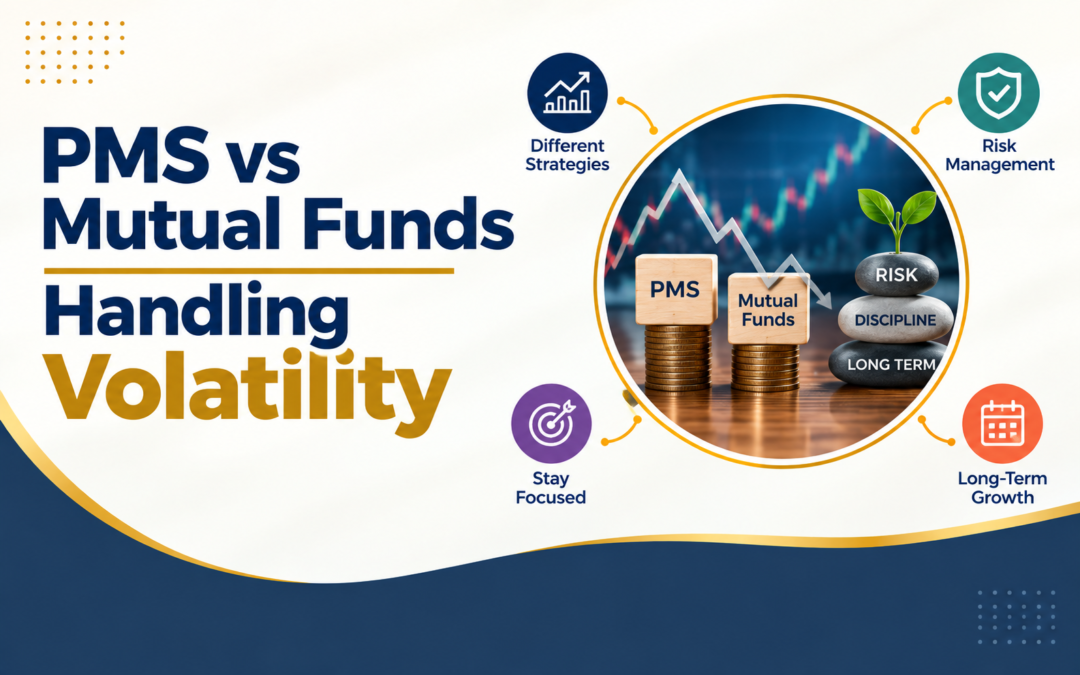
PMS and mutual funds respond to volatility differently because they’re structurally different products. A PMS holds stocks directly in the investor’s name the manager can concentrate into high-conviction positions during a correction or raise cash when risk-reward isn’t there. A mutual fund pools capital across thousands of investors, forcing the manager to stay largely invested, diversify broadly, and manage redemption pressure unrelated to the portfolio. How each handles volatility reflects those structural differences, not just manager skill.
According to the investment team at Chanakya Capital, a SEBI-registered portfolio manager, “a mutual fund manager fighting redemptions in a falling market is forced to sell good stocks to meet outflows a PMS manager with a stable, committed investor base can do the opposite and buy.”
Evaluating a fund manager and trying to separate genuine conviction from well-packaged marketing?
How Does PMS Manage Volatility Differently From a Mutual Fund?
Four structural differences that change how each product behaves when markets fall:
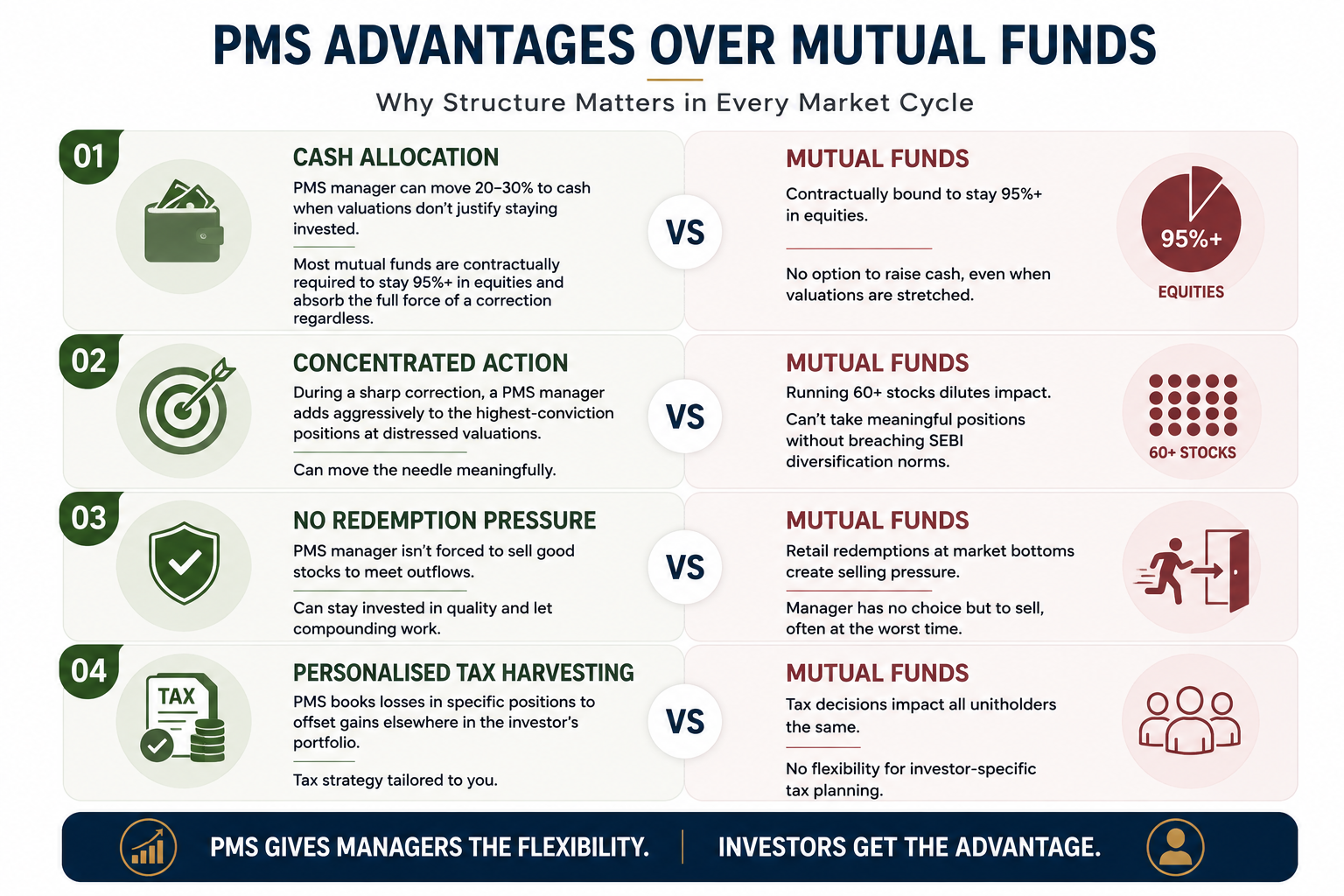
In a severe correction, the difference between a manager who can act with discretion and one constrained by fund structure determines whether volatility becomes an opportunity or just a loss, which is exactly why portfolio management services are built for investors who want that discretion working for them.
Where Does a Mutual Fund Handle Volatility Better Than PMS?
PMS isn’t always the superior structure four situations where a mutual fund’s design actually holds up better:
- Smaller corpus: Below ₹50 lakh, PMS isn’t an option mutual funds give smaller investors diversified equity exposure with professional management, and for a corpus that can’t absorb a concentrated bet going wrong, that diversification is a genuine protective feature rather than a constraint.
- Behavioural guardrails: A mutual fund’s daily NAV and regulated disclosure framework gives anxious investors a transparent, familiar structure a PMS with 15 concentrated positions requires a level of trust in the manager’s process that not every investor has built yet, and without it the investor becomes the risk.
- Liquidity on demand: Open-end mutual funds offer same-day or next-day redemption a PMS can also be liquid, but for investors who genuinely need to access capital at short notice without any friction, the mutual fund’s redemption infrastructure is more reliable.
- Lower minimum: The ₹500 SIP entry point of a mutual fund lets investors build the discipline of staying invested through volatility before committing the ₹50 lakh minimum that PMS requires and that behavioural foundation matters more than most investors realise.
So the question isn’t which product is better at handling volatility in absolute terms. It’s which structure fits the investor’s corpus size, temperament, and time horizon and whether they’ve built enough trust in the manager’s process to stay invested when it matters most.
Why Choose Chanakya Capital?
Chanakya Capital Services Pvt. Ltd. is a SEBI-registered portfolio manager (INP000006040) running concentrated listed equity portfolios for HNIs, NRIs, and family offices through onshore PMS and a Category III AIF at GIFT City IFSC. The portfolio runs 12 to 18 stocks, and the investment team invests its own capital in the same strategies as clients, which means volatility is a shared experience, not just a number on a report sent to investors.
During the 2020 crash, when most mutual funds were forced to sell into falling markets to meet redemptions, Chanakya’s concentrated PMS used the correction to add to highest-conviction positions at prices that hadn’t been available in years. That’s the structural advantage PMS offers but only when the manager has the process and the investor has the conviction to act on it.
FAQ
Frequently Asked Questions
Can a PMS manager hold cash during market volatility?
Yes, unlike most mutual funds, a PMS manager can raise significant cash when valuations don’t justify staying fully invested.
Does PMS offer better tax efficiency than mutual funds during a downturn?
Yes, PMS allows personalised tax loss harvesting at the individual investor level; mutual funds can’t do this.
What is the minimum investment for PMS in India?
SEBI mandates a minimum of ₹50 lakh per investor for any SEBI-registered PMS.
Can mutual funds act with the same discretion as PMS during volatility?
No diversification norms, redemption obligations, and fund size constrain a mutual fund manager’s ability to act decisively during corrections.
