

Earnings are an accounting construct. Cash flow is what hits the bank account. A business can report growing profits while burning cash through aggressive revenue recognition, capitalised expenses, or stretched receivables. Free cash flow tells you whether the earnings are real, whether the dividend holds, and whether capital is being allocated well. In Indian markets, where accounting quality varies widely, cash flow analysis is the first filter.
According to the investment team at Chanakya Capital, a SEBI-registered portfolio manager, “a business earning ₹100 crore but converting only ₹40 crore to free cash flow is telling you something most retail investors never ask what.”
Evaluating a stock on PE alone and wondering why the fundamentals don’t match the price behaviour?
Why Are Earnings an Unreliable Measure of Business Quality?
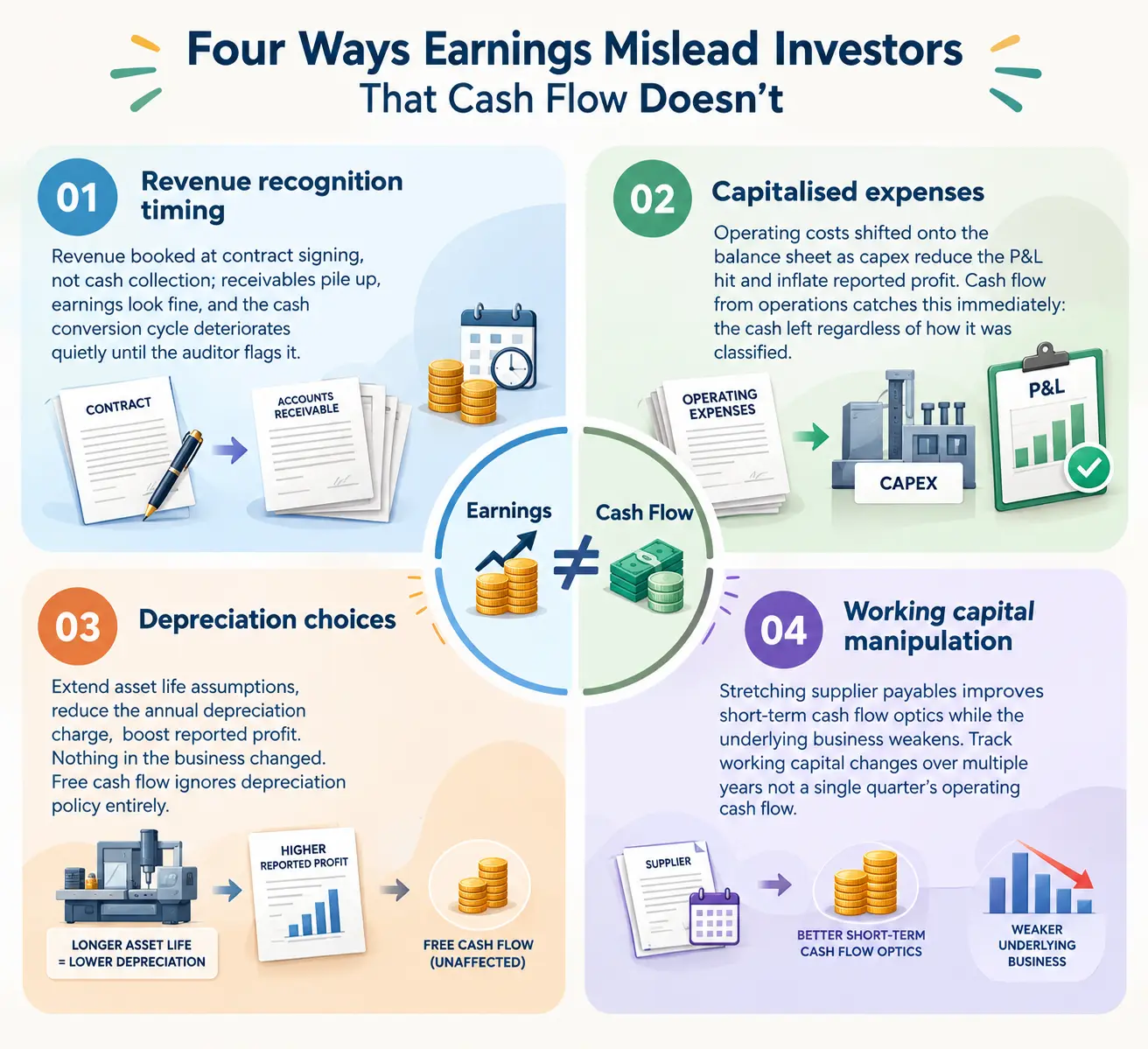
Earnings can be engineered. Cash flow over multiple years is much harder to fake which is why forensic accounting in Indian equities almost always starts with the cash flow statement, not the P&L. See how Chanakya Capital applies cash flow analysis in its stock selection process
How Does Cash Flow Analysis Change Stock Valuation?
Four ways cash flow reframes how a stock should be valued:
- Price to free cash flow: 15x earnings but 35x free cash flow means earnings quality is poor. The PE looks cheap, but the business isn’t generating what the profit number implies. The gap between PE and P/FCF is one of the most useful early warning signals in Indian equity analysis.
- Cash conversion ratio: Operating cash flow divided by net profit over 3 to 5 years. Above 1 means strong earnings quality. Consistently below 0.7: find out what’s absorbing the gap.
- Capex intensity: High earnings with high mandatory capex equals low free cash flow. A business spending ₹80 crore to maintain ₹100 crore of earnings is worth far less than an asset-light business generating the same profit on ₹10 crore of maintenance capex.
- Dividend and buyback sustainability: Paying dividends or buying back shares from borrowings rather than free cash flow destroys value while signalling the opposite. Two minutes with the cash flow statement settles it.
Cash flow analysis doesn’t replace earnings it contextualises them. In a market where promoter-controlled businesses have wide discretion over accounting, that context separates a compounder from a value trap. It’s why spotting a turnaround early starts with the cash flow statement before anything else.
Why Choose Chanakya Capital?
Chanakya Capital Services Pvt. Ltd. is a SEBI-registered portfolio manager (INP000006040). The firm runs concentrated listed equity portfolios for HNIs, NRIs, and family offices through onshore PMS and a Category III AIF at GIFT City IFSC. Every stock passes a cash flow quality filter before valuation work begins. The team won’t own a business that can’t show consistent free cash flow generation across a full cycle.
Thirty-five years of combined Indian equity experience teaches you one thing reliably: PE-cheap, cash-flow-poor businesses destroy capital. It’s not a screening tool here it’s the foundation of every position thesis.
FAQ
Frequently Asked Questions
Why is cash flow more reliable than earnings for stock analysis?
Earnings are affected by accounting choices; cash flow measures what the business actually generated regardless of how costs are classified.
What is free cash flow in simple terms?
Profit after the business has paid for all operating costs and capital expenditure needed to maintain or grow the business.
What is a good cash conversion ratio for an Indian listed company?
Above 1 over a 3 to 5-year average indicates strong earnings quality; consistently below 0.7 warrants detailed investigation.
Can a profitable company have negative free cash flow?
Yes, high capex, working capital build-up, or aggressive accounting can produce reported profits alongside persistent negative free cash flow.