


GIFT City is worth it for NRIs who want Indian equity exposure without NRE/NRO account management, domestic TDS and repatriation caps. It’s not worth it if you pick a badly run fund just because the structure is clean. The IFSC framework is regulated by IFSCA, USD-denominated and separate from domestic Indian tax law, so it solves real problems onshore PMS creates for NRIs. But the structure is only as good as the manager inside it. The choice isn’t GIFT City versus onshore PMS. It’s about which problems you’re trying to solve.
According to the investment team at Chanakya Capital, a SEBI-registered portfolio manager, “the GIFT City structure solves the repatriation and tax problem cleanly but we’ve seen NRIs choose a GIFT City fund with weak investment discipline over a strong onshore PMS purely because the structure sounded better. That’s the wrong trade-off.”
Weighing GIFT City against onshore PMS and not sure which structure actually fits your situation?
What Are the Real Advantages of GIFT City for NRI Investors?
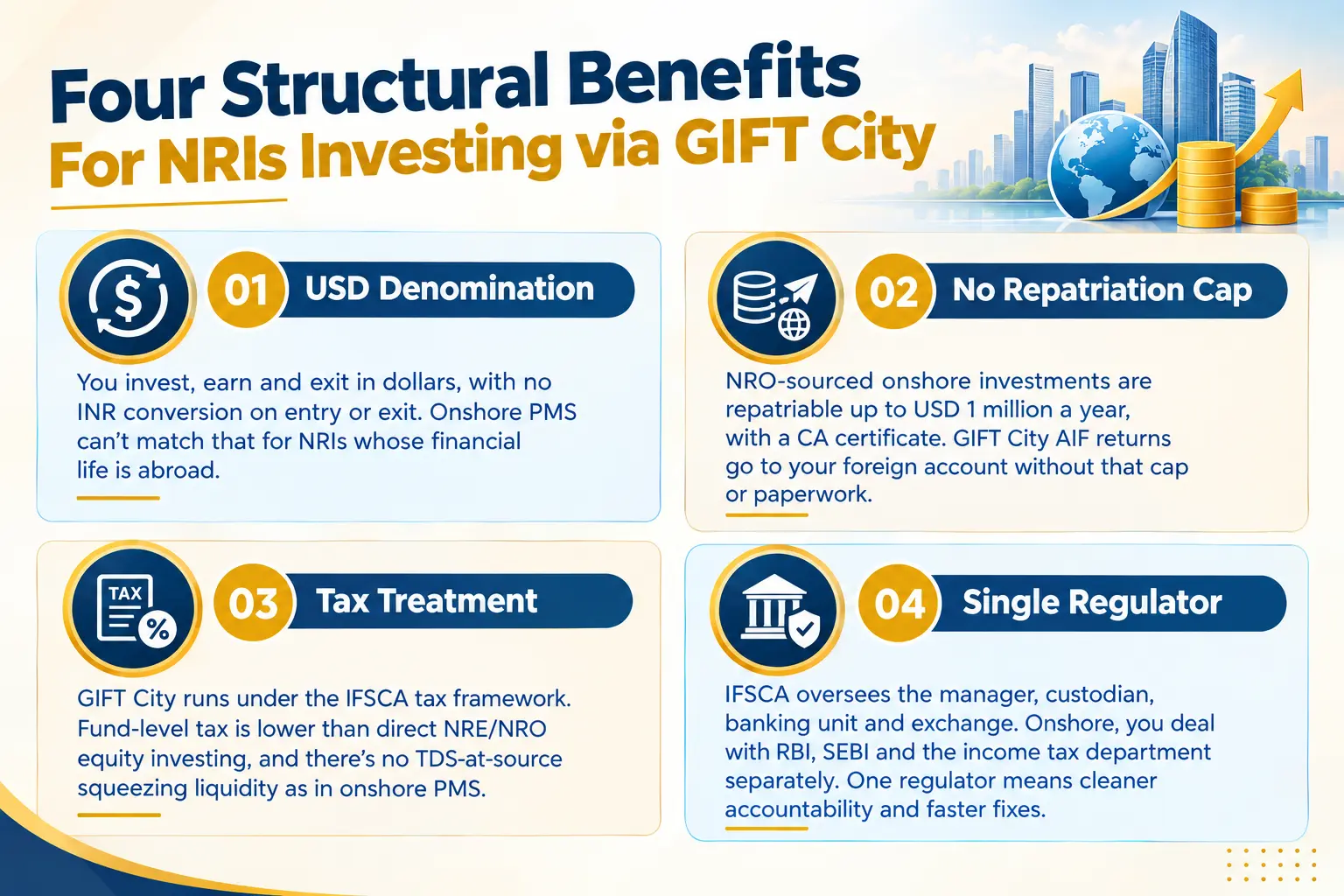
For NRIs with significant India allocations, each of these saves time, money, or both. Learn more about how Chanakya Capital’s GIFT City AIF is structured for NRI investors.
What Are the Genuine Drawbacks NRIs Should Weigh?

None of these are deal-breakers. But treating GIFT City as automatically better than onshore PMS, without running the comparison, is the wrong starting point. That’s why evaluating a PMS track record beyond just returns applies to GIFT City fund selection just as much as onshore.
Why Choose Chanakya Capital?
Chanakya Capital Services Pvt. Ltd. is a SEBI-registered portfolio manager (INP000006040) and one of a select group of boutique managers approved to operate through GIFT City IFSC. The firm offers NRIs both routes: onshore PMS via NRE/NRO for direct Indian equity ownership, and the GIFT City Category III AIF for USD denomination, cleaner repatriation, and a more efficient tax structure. Same investment process. Same concentrated first-principles equity approach. Same managers investing their own capital alongside clients.
The decision between GIFT City and onshore PMS isn’t about which structure is better in the abstract. It’s about account setup, allocation size, tax situation, and repatriation needs — and Chanakya will tell you which fits, not default to whichever is easier to sell.
FAQ
Frequently Asked Questions
Is GIFT City only for NRIs or can resident Indians also invest?
Both NRIs invest directly; resident Indians access GIFT City AIFs through RBI’s Liberalised Remittance Scheme up to USD 250,000 per year.
What is the minimum investment in a GIFT City AIF for NRIs?
Most GIFT City Category III AIFs start at USD 150,000 to USD 250,000; confirm the specific fund’s PPM for the exact threshold.
Is GIFT City AIF better than onshore PMS for NRIs?
For large offshore allocations with repatriation needs, yes, but manager quality matters more than structure for long-term returns.
Are GIFT City AIF returns taxed in India for NRIs?
Fund-level returns are taxed under IFSCA’s framework, not domestic Indian tax law, and are materially lower than standard NRI equity tax rates.
