

NRIs can invest in a SEBI-registered PMS in India, but the rules, tax treatment, and repatriation mechanics differ from resident investors. Investment flows through an NRE or NRO account, requires RBI Portfolio Investment Scheme permission, and sits in a dedicated demat account in the NRI’s name. Tax is deducted at source before proceeds are credited. Repatriation depends on which account the money came from. Getting any one of these wrong costs real money in unnecessary tax, repatriation delays, or FEMA non-compliance the PMS manager can’t fix for you.
According to the investment team at Chanakya Capital, a SEBI-registered portfolio manager, “NRIs who invest in PMS without sorting the account structure first end up with money they can’t repatriate cleanly the investment works, but the exit doesn’t.”
Holding an NRE or NRO account and evaluating whether a PMS fits your India equity allocation?
What Are the Rules for NRI Investment in a SEBI-Registered PMS?
Four regulatory requirements every NRI needs in place before a PMS manager can begin trading:
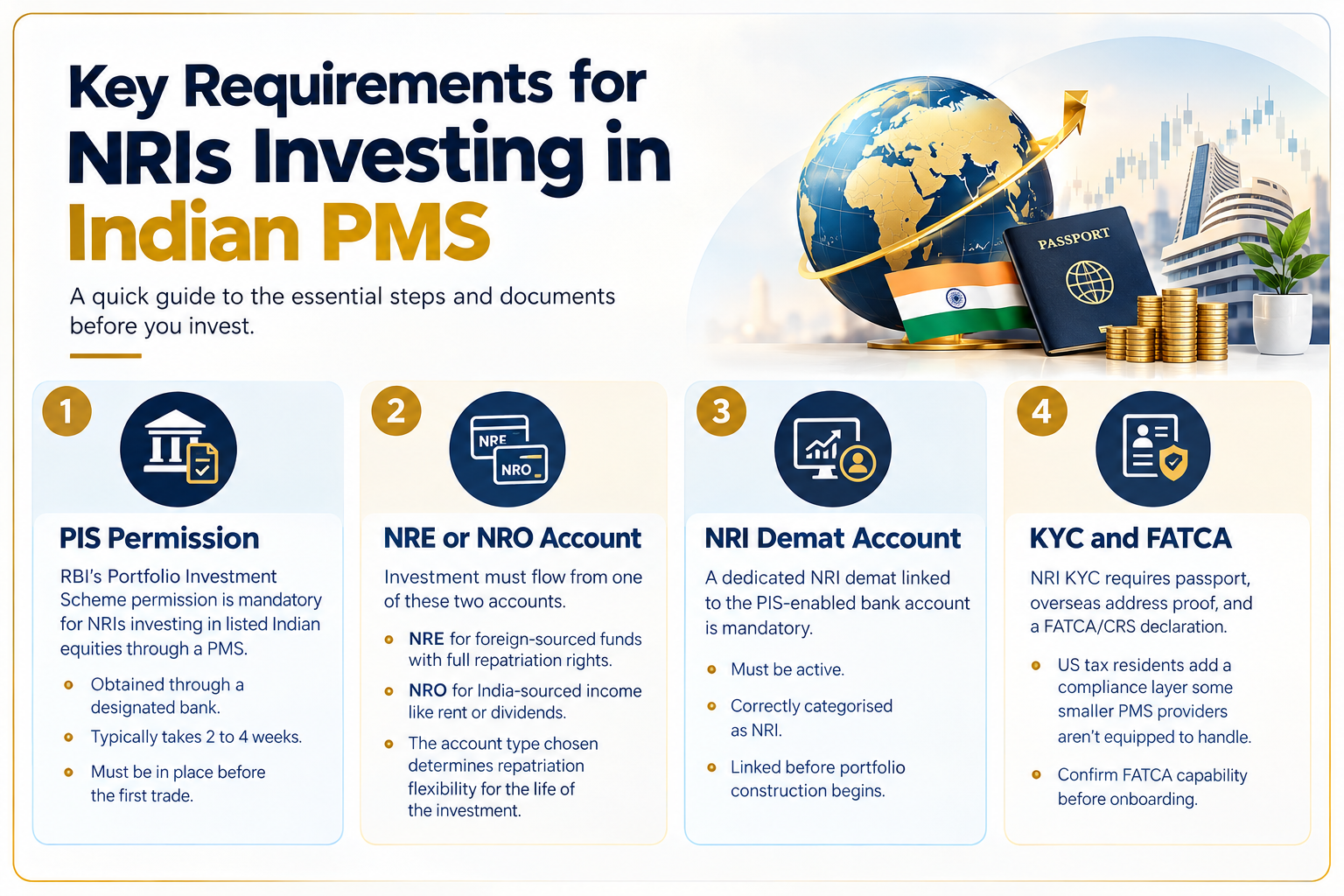
PIS permission requires annual renewal and KYC must stay current for the life of the investment. See who qualifies to invest with Chanakya Capital.
How Are NRI PMS Investments Taxed and Can They Be Repatriated?
Four things that determine what you actually take home after tax and repatriation:
- STCG and LTCG rates: Post-2024 Budget, NRI equity tax rates match resident rates 20% on short-term gains under 12 months, 12.5% on long-term gains above ₹1.25 lakh. Unlike resident investors, NRIs have TDS deducted at source on every transaction.
- TDS and refund: TDS is deducted automatically before proceeds reach the account. Excess TDS is recoverable only by filing an Indian income tax return an annual compliance step most NRIs need a CA to handle.
- NRE repatriation: Funds invested from an NRE account principal and gains are freely repatriable with no annual limit. The cleanest route for NRIs wanting to move returns out of India without friction.
- NRO repatriation: NRO-sourced investments are repatriable up to USD 1 million per financial year after tax, requiring a CA certificate. Workable at the ₹50 lakh minimum but a genuine constraint for larger allocations.
For NRIs with large offshore allocations, a Category II AIF sidesteps the NRO cap and TDS friction entirely USD denomination, no repatriation cap, and a more favourable tax regime under IFSCA.
Why Choose Chanakya Capital?
Chanakya Capital Services Pvt. Ltd. is a SEBI-registered portfolio manager (INP000006040) with 35+ years of combined Indian equity experience, managing concentrated equity portfolios for NRIs, HNIs, and family offices through onshore PMS and a Category III AIF at GIFT City IFSC. The firm handles both routes NRE/NRO-based onshore PMS for NRIs who want direct Indian equity ownership, and the GIFT City AIF for those who prefer USD denomination, cleaner repatriation, and a more efficient tax structure.
The decision between onshore PMS and GIFT City AIF comes down to account setup, allocation size, and how long the capital stays invested. Both are available through Chanakya and the team will tell you which structure actually fits your situation rather than defaulting to the one that’s easier to sell.
FAQ
Frequently Asked Questions
Can NRIs invest in PMS in India?
Yes, via NRE or NRO accounts with RBI’s PIS permission and a minimum investment of ₹50 lakh.
What is PIS permission and why do NRIs need it for PMS?
RBI’s Portfolio Investment Scheme permission is mandatory before an NRI can invest in listed Indian equities through a PMS.
How are NRI PMS gains taxed in India?
STCG at 20% and LTCG at 12.5% above ₹1.25 lakh same as resident rates, but TDS is deducted at source automatically.
Can NRI PMS returns be sent back abroad?
NRE-sourced investments are fully repatriable; NRO-sourced funds are capped at USD 1 million per financial year with a CA certificate.