
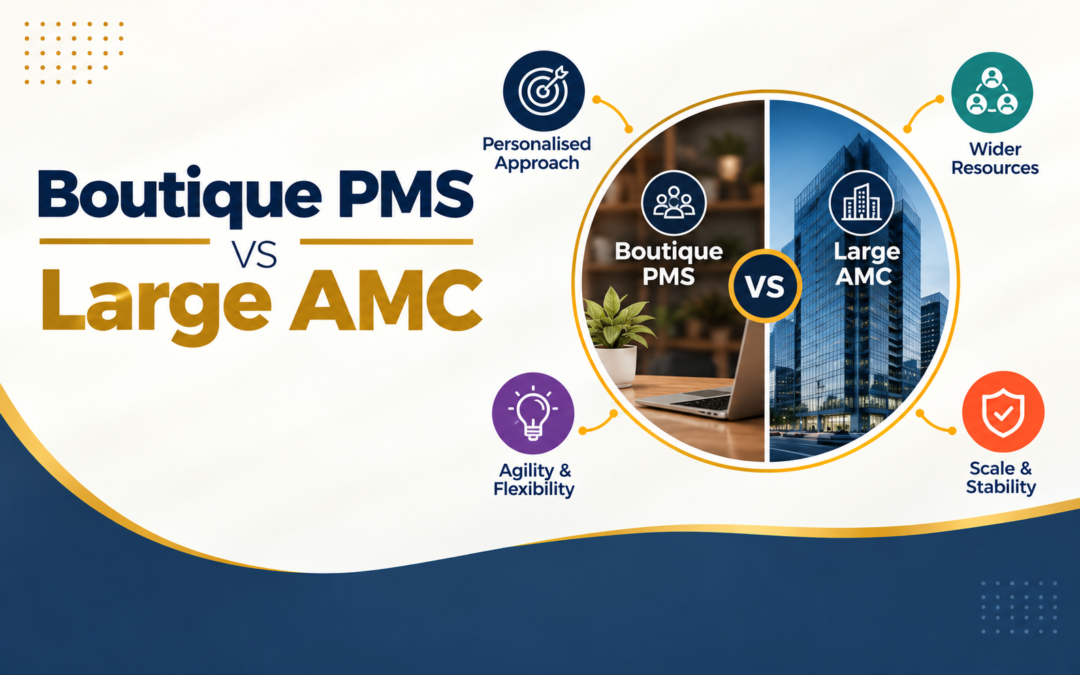
Boutique PMS and large AMC differ in how decisions are made and what they optimise for. A boutique manager runs 12 to 20 concentrated positions, knows every business personally, and has personal capital in the same strategy. A large AMC manages thousands of crores, runs investment committees, and optimises for AUM growth as much as returns. For an HNI investor who wants genuine active management rather than a diluted index with a 2% fee, the process differences matter.
According to the investment team at Chanakya Capital, a SEBI-registered portfolio manager, “a large AMC can’t put 8% of a ₹5,000 crore fund into a mid-cap conviction bet without moving the price against itself a boutique manager with ₹200 crore can, and that’s where the alpha actually lives.”
Paying active management fees and wondering whether you’re getting active management or a dressed-up index?
How Does a Boutique PMS Investment Process Differ From a Large AMC?
Four process differences that determine how each actually manages your money:
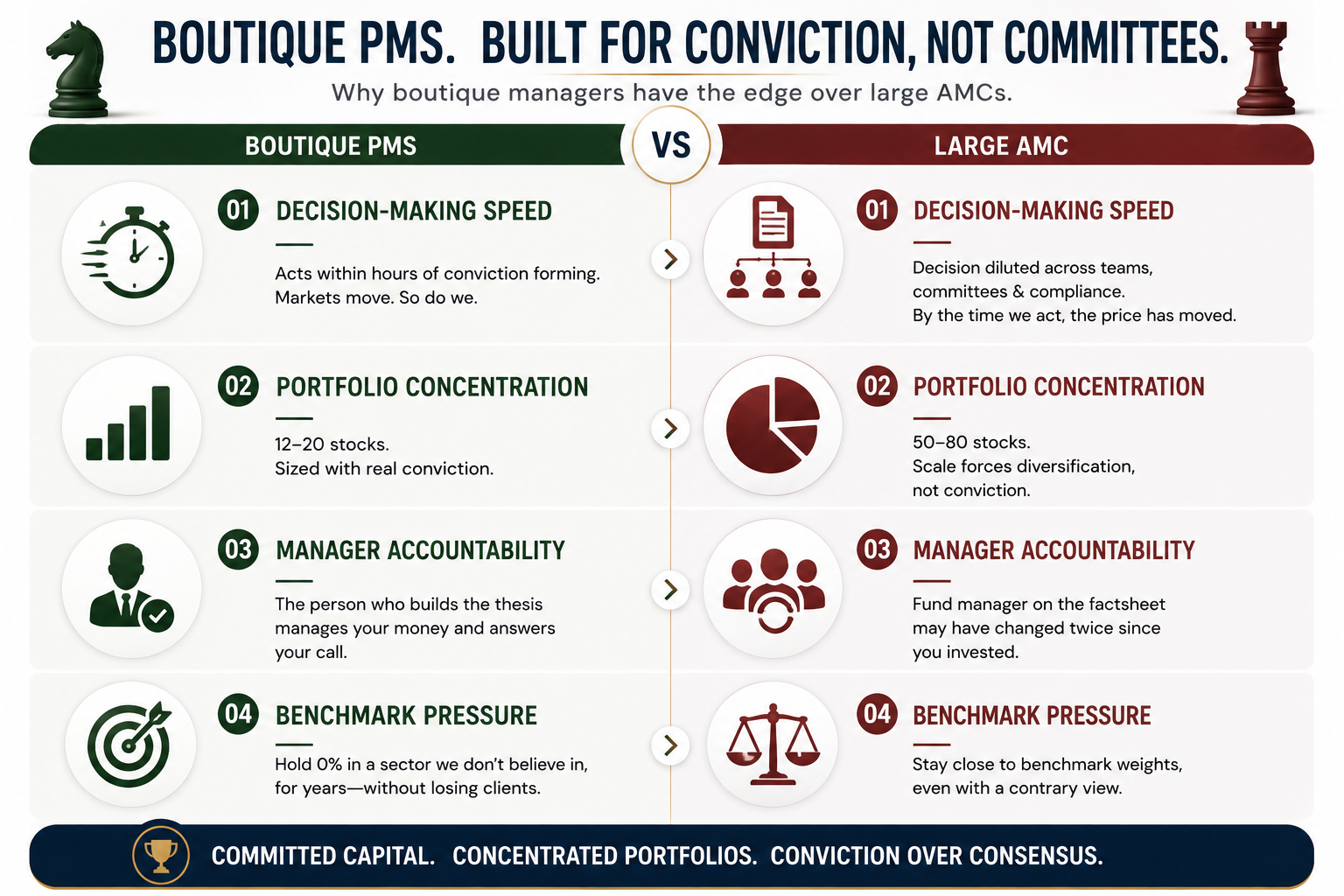
The process advantage shows up in the portfolio’s ability to act decisively, size positions with conviction, and hold through volatility without being second-guessed by a committee which is exactly what discretionary portfolio management is designed to deliver.
Where Does a Large AMC Have a Genuine Edge Over a Boutique PMS?
Four areas where scale and institutional infrastructure actually matter:
- Research depth: A large AMC with 30 analysts covering 200 companies has broader market coverage than a boutique team of 3 to 5 for sectors requiring deep specialist knowledge or global supply chain analysis, that infrastructure produces information a small team can’t replicate.
- Operational stability: Large AMCs have redundant systems, compliance teams, and institutional-grade back office that boutiques can’t always match for investors who weight operational risk alongside investment risk, that matters in stressed market conditions.
- Liquidity at scale: ₹50 crore into a large AMC fund faces no liquidity problem the same amount into a boutique PMS with ₹300 crore total AUM is a meaningful concentration that could affect portfolio flexibility on exit.
- Track record length: Large AMCs have 15 to 20 year histories across multiple cycles many boutique managers are excellent but newer, with 5 to 8 year track records that haven’t been tested across every market environment an investor might want to stress-test against.
The choice isn’t boutique versus large as a matter of principle. It’s whether you’re paying active management fees for a process that can actually deliver active returns or one constrained by its own size from doing so. That’s why how well a PMS manager holds up under scrutiny matters more than the size of the firm running it.
Why Choose Chanakya Capital?
Chanakya Capital Services Pvt. Ltd. is a SEBI-registered portfolio manager (INP000006040) managing concentrated listed equity portfolios for HNIs, NRIs, and family offices through onshore PMS and a Category III AIF at GIFT City IFSC. The team runs 12 to 18 positions, invests personal capital alongside every client, and has 35+ years of combined Indian equity experience across full market cycles including 2008, 2013, 2018, and 2020.
The firm stays deliberately small not because it can’t grow, but because concentration and speed of action are the edge, and both erode with scale. Every client above ₹50 lakh gets the same portfolio the principals run for themselves. No dilution, no benchmark hugging, no committee sign-off on a conviction that was obvious three days ago.
FAQ
Frequently Asked Questions
What is the main difference between a boutique PMS and a large AMC?
Boutique PMS runs concentrated, high-conviction portfolios with direct manager accountability large AMCs manage scale across diversified holdings with committee-driven decisions.
Can a large AMC outperform a boutique PMS?
Yes institutional research depth and operational infrastructure give large AMCs advantages in specific sectors and market conditions.
Why do boutique PMS managers run fewer stocks than large AMCs?
Smaller AUM allows meaningful position sizing in mid and small caps without moving the market large funds can’t deploy capital into smaller companies without creating their own exit problem.
Is a boutique PMS riskier than a large AMC fund?
Concentration risk is higher in a boutique PMS but so is the potential for genuine alpha when the manager’s process is disciplined and the investor has the conviction to hold through volatility.